Rust is the most common surface problem in metal fabrication and industrial maintenance. Left untreated, it eats into structural steel, compromises weld integrity, and causes paint to peel within months. Shops that deal with heavy corrosion regularly — marine repair yards, bridge maintenance crews, agricultural equipment rebuilders — need a removal method that balances speed with surface quality. Chemical rust removers work on light oxidation but fall apart on thick, pitted rust. Sandblasting handles scale well but demands expensive equipment and containment. For many operations, the angle grinder fitted with a wire wheel is still the most practical and cost-effective answer.
The challenge is that not all wire wheels are built for the same job. Walk into any supply aisle, and you will see crimped wheels, knotted wheels, braided cups, stringer bead brushes, and bevel brushes in multiple wire materials and diameters. Pick the wrong one for heavy rust, and you waste hours swapping wheels or burn through a batch of brushes that were only rated for light cleaning. The key differences come down to knot style, wire material, wire diameter, and operating RPM range.
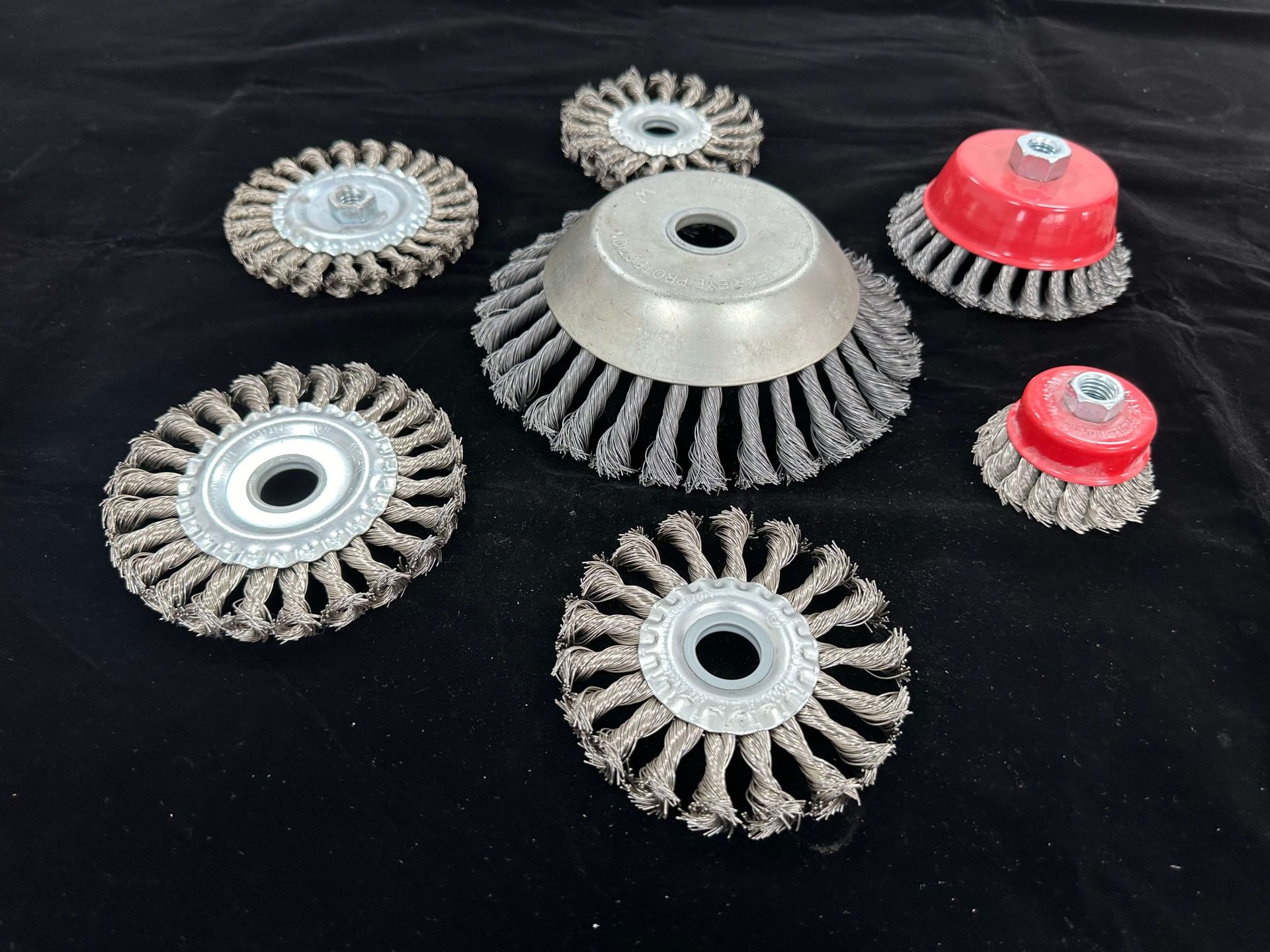
For heavy-duty rust removal on thick steel plate, cast iron, or deeply pitted surfaces, a knotted wire wheel with 0.50 mm stainless steel wire running between 6,000 and 9,000 RPM on a 4.5-inch or 5-inch angle grinder delivers the most aggressive material removal while leaving a surface clean enough for priming or welding. Crimped wire wheels handle lighter surface rust and paint stripping with less gouging, but they lack the cutting force needed for deep corrosion.
Getting the right wire wheel for the job means understanding what each design parameter contributes to the process. Wire type determines cutting aggression and finish quality. Knot configuration controls how much force hits the surface. Wheel diameter and RPM together set the effective surface speed. And technique — pressure, angle, and travel direction — determines whether you strip rust or just polish it. The following sections break down each of these factors so you can match a brush wire wheel to your specific rust removal workload.
How Knotted and Crimped Wire Wheels Differ in Rust Removal
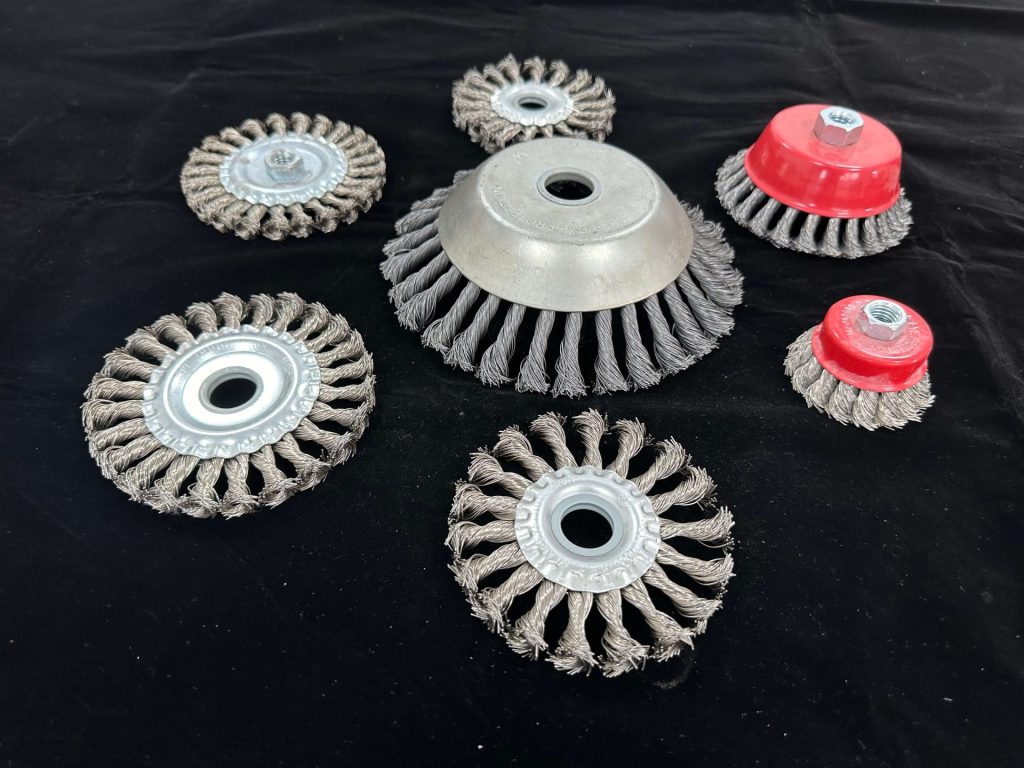
Knotted wire wheels use cables made from twisted wire strands instead of individual straight filaments. Each knot acts like a small rotary hammer, concentrating force at the contact point for fast material removal on thick rust, mill scale, and heavy weld spatter. Crimped wire wheels use individual wavy wires that flex on contact, spreading the impact across a wider area for lighter, more uniform cleaning.
Knotted Wire Construction
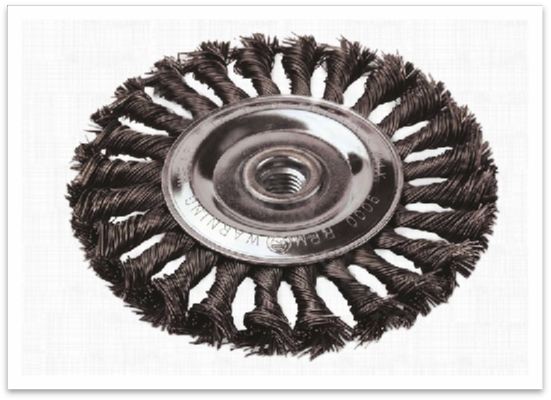
A knotted wire wheel is built by twisting multiple strands of wire into tight bundles — typically single-knot or double-knot configurations — and anchoring those bundles radially around a center ring. When the wheel spins, each knot hits the work surface as a dense, rigid impact point. This concentrated force breaks through hard rust crust, mill scale, and baked-on coatings that a crimped wheel would skate over.
The trade-off is surface finish. Knotted wheels leave a slightly textured surface because each knot digs in deeper. For applications where the part will be welded or primed immediately after cleaning, this texture is often acceptable or even desirable — it gives paint and coatings more mechanical grip. If the final surface must be smooth, a two-step process using a knotted wheel for bulk removal followed by a crimped wheel or flap disc for finishing works better than trying to do everything with one tool.
Knotted wheels also last longer than crimped wheels under the same conditions. The twisted construction resists wire breakage because stress distributes across multiple strands in each bundle. A single broken strand does not cause the entire bundle to unravel, so the wheel keeps its shape and cutting performance deeper into its service life. Manufacturers typically rate knotted wheels for 6,000 to 12,500 RPM depending on diameter, with smaller wheels running faster safely.
Common knotted configurations include:
- Knotted cup brushes: Best for flat and slightly curved surfaces, narrow enough to reach into corners, standard choice for angle grinders in rust removal work
- Knotted wheel brushes: Wider face for larger flat areas, commonly used on bench grinders and dedicated stripping machines
- Stringer bead brushes: Narrow knotted wheels for cleaning weld seams, pipe joints, and tight grooves
Crimped Wire Construction
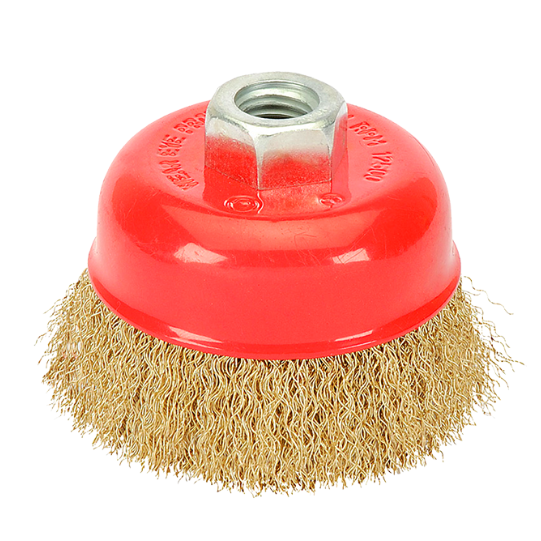
Crimped wire wheels use individual wires that are mechanically waved along their length. Each wire is crimped at regular intervals so that its natural springiness keeps adjacent wires separated. When the wheel contacts the work surface, the wires flex instead of hammering — the impact energy spreads across many wire tips simultaneously.
This flex action makes crimped wheels the right choice for lighter rust, paint stripping, and surface blending. They remove surface oxidation without gouging the base metal, which matters when working on sheet metal, tubing, or finished parts where preserving dimensional accuracy is critical. The flexible wires also conform better to irregular shapes, making crimped wheels more forgiving on curved or contoured surfaces.
The downside is that crimped wheels simply cannot dig through heavy, pitted rust the way knotted wheels can. On thick corrosion, the wires bounce off the surface without biting in. Operators end up pressing harder, which generates excessive heat and accelerates wire fatigue. Crimped wheels also wear faster under high pressure because individual wires break more easily when forced to work beyond their flex range.
If you are unsure which type fits your work, wire wheel selection basics covers the decision framework for matching construction type to specific surface conditions.
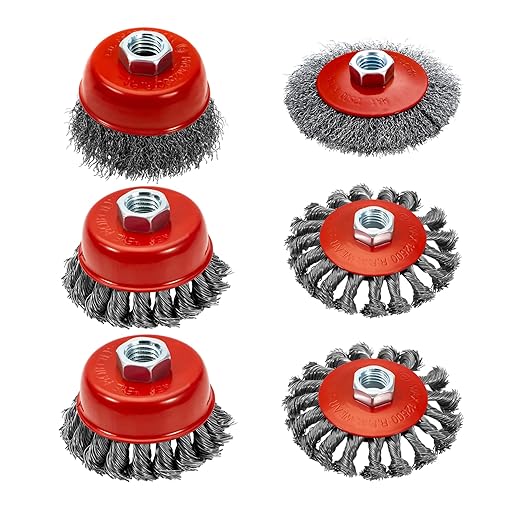
Comparison Table
| Factor | Knotted Wire Wheel | Crimped Wire Wheel |
|---|---|---|
| Cutting aggression | High — concentrated impact per knot | Low to medium — distributed flex action |
| Best for | Heavy rust, mill scale, thick corrosion, weld spatter | Light rust, paint stripping, surface blending, polishing |
| Surface finish | Textured, requires final pass for smooth finish | Smooth, uniform, ready for primer |
| Wire life | Longer — bundles resist breakage | Shorter — individual wires fatigue faster |
| Heat buildup | Higher — friction from aggressive cutting | Lower — wires deflect on contact |
| Typical RPM range | 6,000–12,500 | 4,500–8,000 |
| Contour handling | Better on flat surfaces | Better on curved and irregular shapes |
Why Stainless Steel Wire Outperforms Carbon Steel for Rust Removal
Stainless steel wire wheels prevent the secondary rust problem that carbon steel wire creates. Carbon steel wire leaves microscopic ferrous particles embedded in the cleaned surface, which oxidize within hours and form a thin rust film before paint or primer goes on. Stainless steel wire eliminates this contamination by depositing no ferrous residue on the workpiece.
The Cross-Contamination Problem
When a carbon steel wire wheel runs over a rusted surface, it removes the visible rust layer but simultaneously sheds tiny steel fragments. These fragments, invisible to the naked eye, embed themselves into the cleaned metal. Within 24 to 48 hours — often less in humid conditions — these particles rust, creating a haze of orange discoloration across a surface that looked clean when the operator finished.
This is more than a cosmetic issue. Paint applied over a surface with ferrous contamination loses adhesion at the contamination points. Over time, rust blooms push through the coating from underneath, causing blistering and peeling. In welding applications, ferrous residue from carbon steel wire brushes can contaminate stainless steel welds, creating corrosion-prone weak points at the weld zone.
A stainless steel wire wheel solves this by using stainless wire that contains chromium — typically 12% to 18% depending on the grade. The chromium forms a passive oxide layer that keeps the wire itself from rusting during storage and use. More importantly, any microscopic wire fragments left on the workpiece surface also resist oxidation, so the cleaned surface stays clean until coating.
Wire Material Selection Guide
| Wire Material | Best Application | Limitations |
|---|---|---|
| Stainless steel (304 or 302) | Rust removal on carbon steel, stainless steel, aluminum; marine and food-grade environments | Higher cost per wheel; softer than carbon steel — slightly slower cutting |
| Carbon steel | Heavy mill scale removal, non-critical carbon steel parts, pre-weld cleaning on carbon steel | Leaves ferrous residue; rusts in storage; cannot use on stainless steel |
| Brass / brass-plated steel | Non-sparking applications; soft metal cleaning; delicate surface work | Too soft for heavy rust; wears quickly on steel |
| High-tensile carbon steel | Maximum cutting speed on heavy scale and weld spatter | Worst for leaving ferrous residue; highest risk of secondary rust |
For most industrial rust removal jobs, the slight speed trade-off of stainless steel wire is outweighed by the elimination of post-cleaning rust flash. Shops that switched from carbon to stainless report fewer rework hours spent re-cleaning parts that sat overnight between prep and paint. The procedure for efficient wire wheel rust removal outlines a full step-by-step workflow that accounts for speed, pressure, and angle variables.
Wire Diameter, Wheel Size, and Speed: The Three Variables That Control Performance
Wire diameter determines how much metal each strand can cut per rotation. Thicker wire — 0.50 mm and above — cuts faster and lasts longer on heavy rust but produces a rougher finish. Thinner wire — 0.20 mm to 0.35 mm — gives finer results but wears out faster under aggressive use. Wheel size and RPM together set surface speed, which must stay within the safe operating range for the specific wire diameter and knot type being used.
Wire Diameter and Cutting Performance
Wire diameter is measured in millimeters and typically ranges from 0.20 mm to 0.50 mm or more for industrial wire wheels. The relationship between diameter and performance follows a clear pattern:
- 0.20–0.30 mm: Fine wire for light cleaning, paint preparation, and surface finishing. These wires flex easily and produce the smoothest finish but lack the stiffness to bite into heavy rust. Life expectancy is lower because thin wires fatigue and break faster.
- 0.35–0.40 mm: Medium wire for general-purpose rust removal and surface conditioning. This range balances cutting ability with finish quality and is the most common specification for maintenance shop wire wheels.
- 0.50 mm and above: Heavy-gauge wire for aggressive rust and scale removal. These stiff wires transfer maximum impact force from the grinder motor into the work surface. Finish is rougher, but removal rate is significantly higher.
For heavy-duty rust removal specifically, a 0.50 mm knotted wire wheel on a standard 4.5-inch or 5-inch angle grinder removes material at roughly two to three times the rate of a 0.35 mm crimped wheel on the same tool. The trade-off is higher operator fatigue from the increased vibration and resistance, which becomes a practical consideration on long shifts.
Wheel Diameter and RPM
Wire wheels are rated for a maximum safe RPM that depends on the wheel diameter. Larger wheels must run slower because the outer edge travels at a higher linear speed for the same RPM. Exceeding the rated speed causes centrifugal forces that can separate wires from the hub — a serious safety hazard.
Typical RPM ratings by wheel diameter:
| Wheel Diameter | Typical Max RPM | Common Grinder Size |
| 3 inch (75 mm) | 12,500 | Die grinder, straight grinder |
| 4 inch (100 mm) | 11,000 | 4-inch angle grinder |
| 4.5 inch (115 mm) | 9,000 | 4.5-inch angle grinder |
| 5 inch (125 mm) | 8,000 | 5-inch angle grinder |
| 6 inch (150 mm) | 6,600 | 6-inch bench grinder |
| 8 inch (200 mm) | 4,500 | 8-inch bench grinder |
Always match the wheel’s rated RPM to the grinder’s no-load speed. A grinder rated at 11,000 RPM will overspeed a wheel rated for 8,000 RPM even at partial throttle, because operators tend to run tools at full speed. The RPM rating is stamped on every quality wheel’s metal center ring or label — never use a wheel where this marking is illegible or missing.
A wire wheel for a grinder designed for 4.5-inch angle grinders with knotted stainless steel construction hits the sweet spot for most heavy rust removal tasks. The 9,000 RPM rating matches the no-load speed of common professional-grade angle grinders, and the 4.5-inch diameter covers enough surface area per pass without being unwieldy in tight spaces.
Surface Speed and Effective Cutting
Surface speed — the linear speed of the wire tips in feet per minute — is the product of RPM and wheel circumference. Higher surface speed means more wire tips hitting the surface per second, which translates to faster material removal up to a point. Beyond that point, the wires bounce instead of cutting, and heat buildup becomes excessive.
For knotted stainless steel wire wheels, the effective surface speed range for heavy rust removal falls between 4,000 and 6,500 surface feet per minute. This corresponds to roughly 3,400 to 5,600 RPM on a 4.5-inch wheel. Running at the grinder’s full 9,000 RPM is possible but often counterproductive on thick rust because the wheel skips across the surface rather than digging in.
Techniques That Make or Break Rust Removal Results
Applying steady moderate pressure at a 15-to-20-degree angle to the surface, moving in one consistent direction, produces the fastest rust removal with the fewest wire breakages. Excessive pressure forces wires to overheat and fracture. Too flat an angle causes the wheel to skate. Changing direction mid-pass creates an uneven surface texture that shows through paint.
Pressure Control
The instinct to press harder when rust does not come off immediately is the most common mistake in wire wheel operation. Wire wheels cut through friction and impact, not pressure. A knotted wire wheel at the right RPM removes rust because the knot tips hammer the corrosion layer at thousands of impacts per second. Adding body weight behind the grinder does not increase the impact force — it only compresses the wires and generates friction heat.
Heat is the enemy of wire wheel life. When wires overheat, they lose temper and become brittle. A wheel that should last through a full shift can degrade in under an hour of heavy-handed operation. The wire tips turn blue from heat oxidation, and breakage rates climb sharply.
A practical rule: if the wire tips are changing color during use, back off the pressure. The wheel should feel like it is working, not fighting. On a 4.5-inch angle grinder with a knotted wheel, the tool should be manageable with one hand at waist level — if you need both hands and a braced stance to control it, you are pressing too hard.
Working Angle and Direction
The angle between the wheel face and the work surface directly affects both removal rate and finish quality:
- 0–5 degrees (wheel face flat against surface): Minimal cutting action because wire tips cannot bite into the corrosion layer. The wheel skates across the surface. High risk of the grinder kicking or walking.
- 10–20 degrees: Optimal range. Wire tips hit the surface at an angle that allows cutting while keeping the wheel controllable. This is the working angle for most rust removal.
- 25–35 degrees: Maximum aggression. Deeper cutting but rougher finish and harder to control. Use for initial passes on extremely thick rust, then reduce angle for blending.
- Above 35 degrees: Only the edge of the wheel contacts the surface. Very aggressive localized cutting but poor coverage and high risk of gouging.
Direction consistency matters for the final appearance. Running the wheel in overlapping parallel passes in one direction produces a uniform surface texture. Random directional changes leave visible swirl marks that remain visible after painting, especially under gloss coatings.
For a complete breakdown of the workflow from inspection through final cleaning, the heavy rust removal guide covers tool setup, surface preparation, and post-cleaning treatment steps that prevent flash rust from forming before coating.
Safety Practices
Wire wheels throw debris at high velocity and can grab clothing or gloves. Essential precautions include:
- Full-face shield over safety glasses — wire fragments can penetrate standard safety glasses
- Leather apron or heavy cotton work clothes — no loose sleeves or dangling cords
- Heavy leather gloves that fit snugly at the wrist
- Hearing protection — extended wire wheel use on an angle grinder exceeds 90 dB
- Workpiece secured with clamps or a vise — never hold small parts by hand
- Grinder guard installed and correctly positioned between the operator and the wheel
A steel brush for grinder with a properly fitted guard reduces the risk of wire ejection injuries and keeps the wheel balanced under load. Always inspect a new wire wheel for loose wires or uneven knot distribution before mounting, and run it at full speed for 30 seconds away from the workpiece to confirm it spins true.
Choosing the Right Wire Wheel: A Decision Framework
The right brush wire wheel for heavy rust removal comes down to four decisions, made in this order:
- Surface severity: Heavy, pitted rust with scale → knotted wheel. Light surface rust or flash rust → crimped wheel.
- Wire material: Carbon steel parts that will be painted → stainless steel wire. Non-critical parts or one-time cleaning where flash rust is acceptable → carbon steel wire.
- Wire diameter: Deep corrosion on thick plate → 0.50 mm wire. Moderate rust on mixed-thickness material → 0.35 mm wire. Light rust on sheet metal → 0.30 mm wire.
- Wheel size and RPM: Match to your grinder. Most shops standardize on 4.5-inch wheels at 9,000 RPM because that combination covers the widest range of common rust removal work.
For shops handling mixed workloads — some days heavy structural rust, other days sheet metal cleanup — keeping both a knotted stainless wheel and a crimped stainless wheel on hand avoids the frustration of trying to make one wheel do everything. The knotted wheel stays on one grinder for heavy work, the crimped wheel on another for finishing, and neither machine gets reconfigured between jobs.
FAQ
Can I use the same wire wheel on carbon steel and stainless steel?
No. Once a wire wheel has been used on carbon steel, it carries ferrous contamination that can embed into stainless steel surfaces and cause corrosion at the contamination points. Dedicate separate wire wheels to carbon steel and stainless steel work, and label or color-code them so they never get mixed up in a shared tool rack.
How do I know when a wire wheel needs replacement?
Watch for three signs: uneven wear that creates a lopsided or vibrating wheel, wire breakage concentrated in a narrow band that reduces the working face width, and visible blue or brown discoloration on wire tips from heat damage. A worn wheel also throws more wires per minute of use — if you are stopping frequently to pick wire fragments out of clothes or gloves, the wheel has reached the end of its service life.
Does wire wheel diameter affect how fast rust comes off?
Both matter, but surface speed — the linear speed of the wire tips — is what determines cutting rate. A 6-inch wheel at 6,600 RPM has a higher surface speed than a 4-inch wheel at 11,000 RPM due to the larger circumference, so it actually cuts faster despite the lower RPM. However, larger wheels are harder to control freehand on an angle grinder, which is why 4.5-inch and 5-inch wheels remain the standard for handheld rust removal even though bench-mounted larger wheels offer higher theoretical cutting speeds.