Surface preparation on flat metal plates is straightforward. A standard steel round brush mounted on an angle grinder runs across in predictable passes, with all bristles making uniform contact. But industrial cleaning rarely happens on perfect planes. Pipe elbows, stamped brackets, cast housings, weld beads, automotive body panels—these surfaces curve, dip, and twist in ways that punish rigid tools. A steel round brush that performs well on flat stock may struggle on contoured geometries, making brush selection critical for shops that work with varied part profiles.
The question comes up regularly in fabrication shops and maintenance bays: can a single tool handle both flat stock and contoured parts, or do you need separate brushes for each geometry? The answer matters because switching tools mid-job costs time, and buying specialized brushes for every profile adds up.
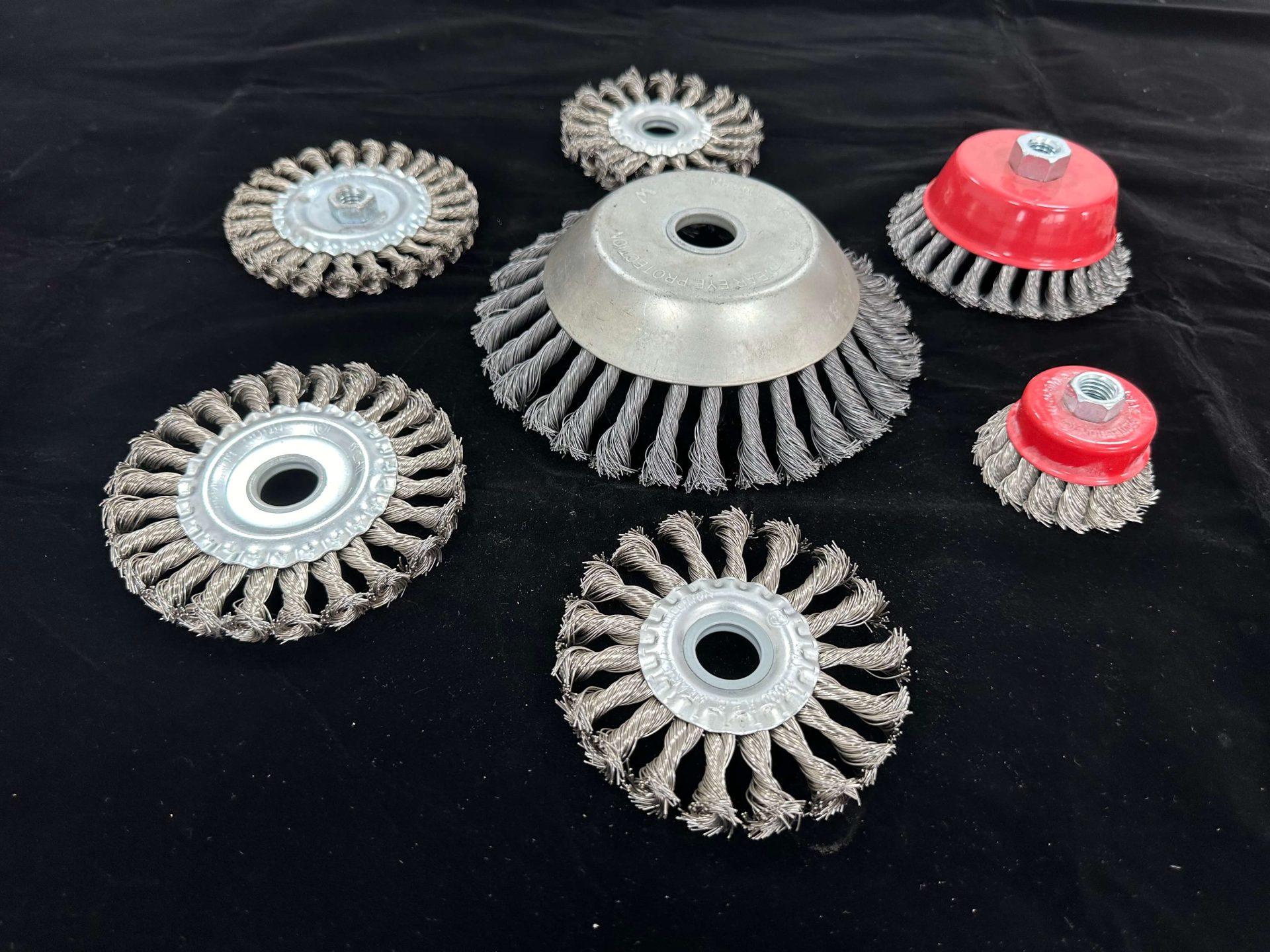
Yes, a steel round brush works on curved and irregular surfaces—but the result depends almost entirely on the brush type, wire configuration, and operating technique. Crimped wire wheel brushes flex to follow contours without gouging, while knotted wire brushes deliver aggressive material removal on uneven geometries when applied at the correct angle. The key is matching filament type and wheel design to the surface complexity you face.
Choosing the wrong steel round brush for contoured work leads to two outcomes: either the bristles skip over recessed areas, leaving rust and scale behind, or they dig into raised features and alter the part profile. Neither is acceptable in industrial surface prep. What follows covers the brush configurations that actually conform to irregular shapes, the wire grades that offer the right stiffness-to-flexibility balance, and the techniques that make round brushes perform on geometries they were not originally designed for.
How Wire Configuration Affects Conformity to Curved Surfaces
Crimped wire round brushes conform to curved and irregular surfaces far better than knotted wire brushes. The wavy, separated filaments bend independently, allowing the brush face to adapt to peaks and valleys without excessive pressure. Knotted wire brushes, while more aggressive, resist flexing and work best on mild contours where their cutting power is needed.
Crimped Wire: Flexibility That Follows the Profile
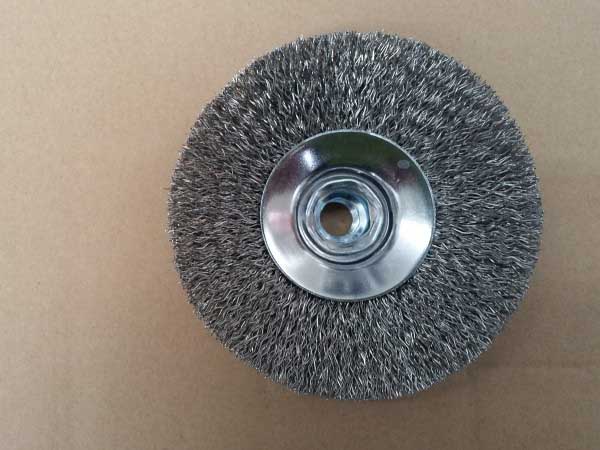
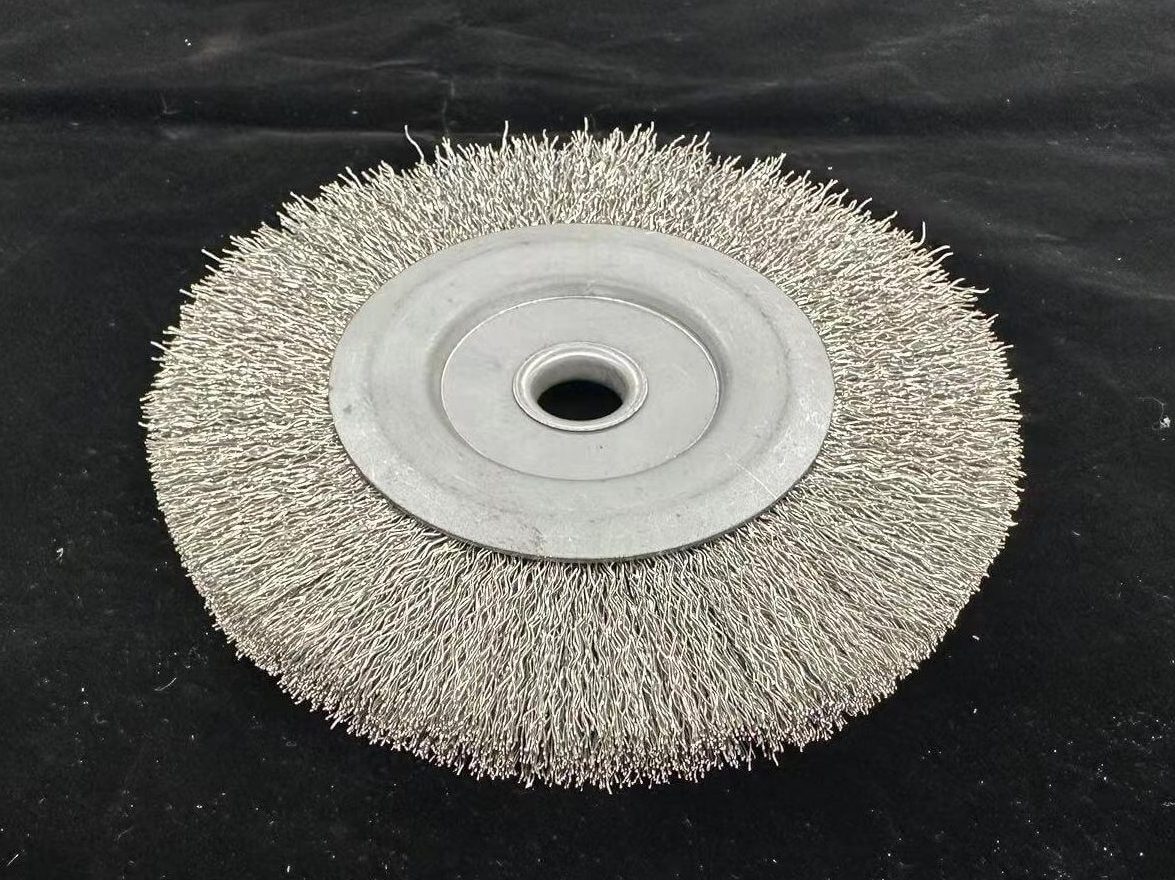
A crimped wire wheel brush has individual filaments with a wavy, sinusoidal shape along their length. These wires do not interlock with each other. Each bristle bends under its own spring tension and returns to shape, independent of its neighbors. When the brush contacts a raised weld bead, the filaments in that zone compress while adjacent wires continue making contact with the surrounding surface.
This independent flex behavior is what makes crimped wire the go-to choice for irregular surfaces. A 4-inch crimped steel round brush running at 4,500 RPM can clean inside a concave casting depression while the outer bristles simultaneously work the rim area. The brush face molds to the surface rather than forcing the surface to match the brush.
The trade-off is aggressiveness. Crimped filaments remove rust, light scale, and old paint effectively, but they will not strip heavy mill scale or thick weld spatter in a single pass. For those tasks, multiple passes or a different brush type make more sense.
Crimped wire configurations also produce less heat at the contact point. Because individual wires deflect rather than resist, less friction energy transfers into the workpiece. This matters when working with thin-gauge metal where heat distortion can warp the part. Operators running crimped wheel brush configurations on auto body panels report fewer warping issues compared to knotted alternatives.
Knotted Wire: Power Over Flexibility
Knotted wire wheels take a different approach. Filaments are twisted together in rope-like bundles, creating a stiffer, more aggressive cutting face. Each bundle acts as a single unit rather than as individual bristles. This design excels at removing heavy rust, scale, and weld spatter from flat or gently curved surfaces.
On irregular surfaces, knotted brushes demand more operator skill. The stiff bundles will not automatically conform to dips and ridges. Instead, the user must angle the tool to direct the cutting edge into recessed areas while avoiding excessive dwell time on raised features. Applied correctly, a knotted wire brush cleans pipe threads, removes heavy corrosion from structural beams with minor surface variation, and strips thick coatings faster than any crimped alternative.
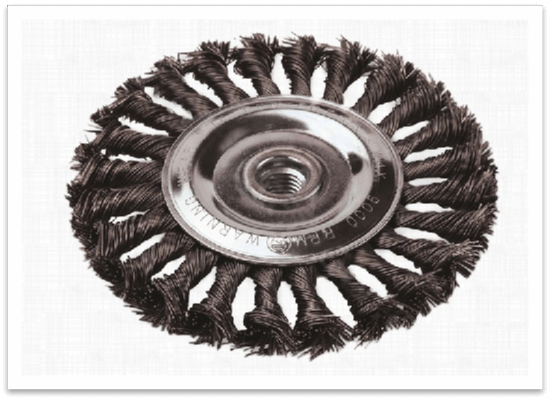
The wire grade also matters. A stiff carbon steel filament between 0.023 and 0.035 inches in diameter, mounted in a knotted configuration, cuts aggressively but flexes less. For contoured work where some conformity is still needed, dropping to a medium-grade wire (0.014 to 0.020 inches) in a knotted pattern gives a middle ground—enough stiffness to cut, enough give to follow gentle curves.
Steel Round Brush Types and Their Performance on Irregular Geometries
Wheel brushes, cup brushes, and end brushes each handle irregular surfaces differently. Wheel brushes clean along edges and narrow grooves when the operator presents the brush face at a 15 to 30-degree angle. Cup brushes cover broad contoured areas with the brush face parallel to the surface. End brushes reach into holes, internal corners, and tight profiles that larger brushes cannot access.
Wheel Brushes: Edge Contact for Grooves and Joints
A standard steel wheel brush cleans with its edge, not its face. The brush spins perpendicular to the workpiece, and the wire tips along the circumference do the work. On a flat plate, the contact zone is a thin line. On a curved surface like a pipe or a fillet weld joint, that line wraps partially around the contour.
This edge-contact geometry makes wheel brushes effective for cleaning inside V-grooves, along weld seams, and around pipe joints. A 3-inch twisted steel wire round brush can follow a 2-inch radius pipe weld, removing slag and discoloration from both sides of the joint in a single controlled pass. The narrow contact zone concentrates cleaning energy exactly where needed.
The limitation is width. Wheel brushes cover a thin strip per pass. On broad curved surfaces like tank walls or ship hull plates, a 0.25-inch face width means many overlapping passes. For these applications, a cup brush often works faster.
Cup Brushes: Face Contact for Broad Contours
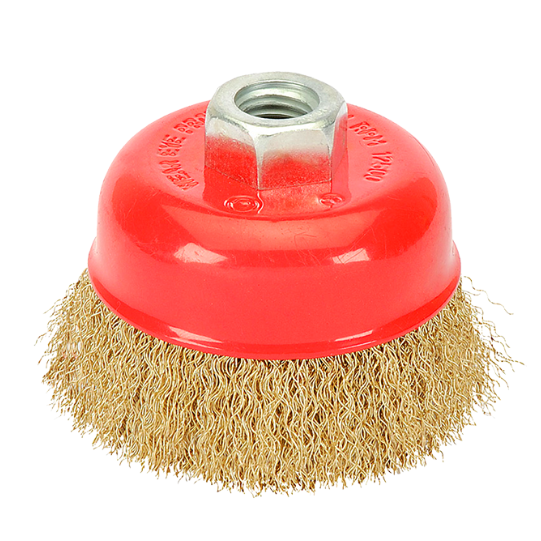
Cup brushes orient the wire filaments parallel to the tool axis, creating a circular cleaning face rather than an edge. When pressed against a surface, the entire brush face makes contact. On curved surfaces, the brush face tilts slightly to follow the contour, maintaining broad contact across a much larger area than a wheel brush.
A 4-inch crimped steel cup brush cleaning a curved automotive frame rail covers roughly 10 to 15 times the surface area per pass compared to a wheel brush on the same part. The crimped wires compress against the surface, following the rail’s curvature without requiring the operator to constantly adjust tool angle.
For bowl-shaped or domed surfaces, cup brushes are the natural choice. The brush face seats into concave areas, and the operator can rock the tool slightly to distribute wear evenly across the filaments. This extends brush life and produces a more uniform surface finish than wheel brush edge work on the same geometry.
End Brushes: Reach Into Tight Profiles
End brushes—small round brushes with filaments extending from the tip—solve a specific problem on irregular parts: access. Cast brackets with internal pockets, machined parts with blind holes, and stamped components with folded edges all trap rust and debris in spaces too tight for a standard wheel or cup brush.
An end brush with a 1-inch diameter and stainless steel filaments reaches into these confined areas, cleaning surfaces that would otherwise require manual scraping or chemical treatment. The small diameter works at higher RPM than larger brushes, and the filament tips clean perpendicular to the tool axis, making contact with the bottom and side walls of recessed features.
For complete surface coverage on complex geometries, shops often pair a cup brush for broad areas with an end brush for tight corners, eliminating the need for secondary manual operations.
Material Selection: Carbon Steel vs. Stainless Steel Wire for Contoured Work
Carbon steel wire provides higher cutting aggressiveness at lower cost, making it the default choice for contoured carbon steel workpieces. Stainless steel wire is required when cleaning stainless steel or aluminum surfaces to prevent ferrous contamination and rust staining. The material choice affects not just corrosion compatibility but also wire stiffness and fatigue life on irregular surfaces.
Carbon Steel: Cost-Effective Aggression
Carbon steel wire filaments are the workhorse of industrial surface preparation. They cut faster than stainless steel wire of the same diameter because carbon steel has higher tensile strength in the drawn wire form used in brush manufacturing. For a metal wire brush operating on carbon steel parts—structural beams, cast iron housings, mild steel weldments—carbon steel wire is the economical and technically correct choice.
The downside is oxidation. Carbon steel wire rusts. Brushes stored in humid environments develop surface rust on the filaments, which then transfers to the workpiece on the next use. For parts destined for painting or coating, this surface rust must be cleaned off before finishing. Dry storage and occasional light oiling of carbon steel brushes minimize this issue.
On irregular surfaces, carbon steel wire’s higher stiffness can be either an advantage or a problem. For removing heavy rust from deeply pitted castings, stiff carbon steel wire reaches into pits and breaks up corrosion. For cleaning thin stamped brackets with complex folds, the same stiffness risks snagging on edges and bending the part. Wire diameter selection becomes critical—dropping from 0.023-inch to 0.014-inch carbon steel wire dramatically increases flexibility at the cost of some cutting speed.
Stainless Steel: Contamination Prevention
Stainless steel wire brushes exist for one primary reason: preventing free iron contamination on stainless steel and aluminum workpieces. When a carbon steel brush runs across a 304 stainless steel part, microscopic iron particles embed in the surface. These particles oxidize, creating rust spots on a material chosen specifically for corrosion resistance. The result is a part that fails inspection or corrodes prematurely in service.
Stainless steel wire wheel brush configurations eliminate this contamination pathway. The 302, 304, or 316-grade stainless filaments match the workpiece material, leaving no foreign iron behind. This is mandatory for food processing equipment, marine hardware, pharmaceutical vessels, and architectural stainless steel.
Stainless steel wire is stiffer than carbon steel wire at the same diameter. A 0.014-inch stainless filament behaves more like a 0.020-inch carbon steel filament in terms of flex resistance. For highly contoured stainless parts, stepping down one wire diameter from what the operator would use in carbon steel helps maintain conformity without sacrificing cleaning effectiveness.
Operating Techniques for Curved and Irregular Surfaces
The right technique matters as much as the right brush. Maintaining a 15 to 30-degree approach angle, using light to moderate pressure, and keeping the brush moving across the surface prevent gouging on contoured workpieces. Letting the tool’s RPM do the cutting—rather than operator force—produces cleaner results with less brush wear.
Approach Angle and Pressure Control
The angle between the brush face and the workpiece determines how the wire tips interact with the surface. At 0 degrees—brush face parallel to surface—the wires hit flat and deflect outward, producing a polishing action with minimal cutting. At 90 degrees—brush edge perpendicular—only the very tips make contact, concentrating all energy into a tiny contact zone. For irregular surfaces, the sweet spot is 15 to 30 degrees.
At this angle, some wires make tip contact for cutting while others compress and flex, adapting to local surface variation. The operator sees the brush following contours naturally rather than skipping across peaks. On a curved pipe, maintaining this angle as the brush moves around the circumference ensures consistent cleaning across the full arc.
Pressure should be light enough that the grinder does not bog down and the wire tips do not flatten permanently. A common mistake is pressing harder when the brush appears to slow down. What is actually happening is that the wire tips have dulled or the brush is clogged with debris. Pressing harder accelerates wire breakage and can score the workpiece. A light touch, letting the brush’s rotation do the work, extends filament life and produces a more even surface finish.
Movement Patterns for Complete Coverage
Irregular surfaces rarely clean evenly with straight-line passes. Overlapping circular or figure-eight patterns work better because they vary the brush’s approach angle continuously, exposing the filament tips to different parts of the surface profile with each pass.
For parts with deep recesses, start with the brush oriented to reach into the low areas first. Clean the valleys while the brush is fresh and the wires are at full length. Then switch to broader passes for the raised areas. This sequence prevents the frustration of finishing the accessible surfaces only to find the brush too worn to reach into the tight spots.
Edge awareness is critical on stamped and fabricated parts. Wire brush filaments can catch on sharp corners, sheet metal edges, and burrs, potentially kicking the tool back toward the operator. Approach edges from the solid side rather than the open side, and reduce pressure near corners until the operator has a feel for how the brush interacts with that specific geometry.
Matching Brush Specifications to Surface Complexity
Surface finish requirements often dictate brush specification as much as the cleaning task itself. A part heading for powder coating can tolerate a slightly rougher surface than one receiving a thin-film liquid coating. Cratered castings need different brush characteristics than smooth stamped panels.
The table below maps common surface scenarios to recommended steel round brush configurations:
| Surface Type | Recommended Wire Type | Wire Diameter | Configuration | RPM Range |
|---|---|---|---|---|
| Smooth curved panels (auto body) | Crimped carbon steel | 0.010″ – 0.014″ | Wheel or cup | 4,500 – 6,500 |
| Pipe and tube exteriors | Crimped carbon or stainless | 0.014″ – 0.020″ | Wheel | 6,500 – 8,500 |
| Cast iron housings (heavy rust) | Knotted carbon steel | 0.023″ – 0.035″ | Cup | 6,500 – 8,500 |
| Weld cleaning (mild contours) | Knotted carbon steel | 0.020″ – 0.023″ | Wheel | 8,500 – 12,000 |
| Stainless steel fabrications | Crimped stainless steel | 0.010″ – 0.016″ | Wheel or cup | 4,500 – 6,500 |
| Deep recesses / internal corners | Crimped carbon steel | 0.010″ – 0.014″ | End brush | 12,000 – 20,000 |
The wire wheel brush selection process always starts with the workpiece material and the surface condition. A brush that works on smooth, lightly rusted steel will fail quickly on pitted cast iron with thick scale. Bringing the workpiece to the selection criteria—rather than forcing a brush to work outside its design envelope—is how experienced operators avoid rework.
Filament length also affects contour-following behavior. Longer trim lengths (the exposed wire beyond the hub) increase flexibility but reduce cutting aggressiveness. Shorter trim lengths stiffen the brush and improve cutting action at the cost of conformity. A 1-inch trim length on a 4-inch wheel brush provides a good balance for general contoured work.
Brush life on irregular surfaces runs shorter than on flat work. The constant flexing of filaments as they adapt to surface variation accelerates fatigue. Operators should expect 20 to 30 percent fewer work-hours from a brush used primarily on contoured parts compared to the same brush on flat stock. Building this replacement schedule into job costing prevents surprises.
Steel Brushes for Grinders: Tool Compatibility and Safety
Mounting a steel brush for grinder applications requires matching the brush arbor to the tool spindle. Most angle grinders in North America use a 5/8-inch-11 threaded arbor. Smaller die grinders and drills may use 1/4-inch round shanks or M14 threads. An adapter between incompatible sizes introduces runout, which causes vibration, uneven wear, and potential brush failure.
RPM ratings are non-negotiable. Every wire brush carries a maximum RPM stamped on the hub or packaging. Exceeding this rating causes wire filaments to break at the root and fly outward. A brush rated for 12,500 RPM mounted on a grinder running at 13,000 RPM may not fail immediately, but wire fatigue accelerates and the risk of injury increases. Always verify that the tool’s free-speed RPM is below the brush’s maximum rating.
Safety equipment for wire brush work includes full-face protection or tight-fitting safety glasses with side shields, heavy gloves, and hearing protection. Wire filaments shed during use, and fragments embed in clothing and skin. Long sleeves and a leather apron provide additional protection. Working in a well-ventilated area or with dust extraction reduces inhalation of rust and coating particles lifted by the brush.
The stainless steel wire brushes used on food-grade and marine equipment demand additional precautions. Dedicate brushes to specific material types and label them clearly. A brush used on carbon steel, even once, carries iron residue that contaminates subsequent stainless steel work. Color-coding brush hubs or storage racks by material type is a low-cost way to prevent cross-contamination errors.
When a Steel Round Brush Reaches Its Limits
Steel round brushes handle most contoured surface preparation tasks in a typical fabrication environment, but they are not universal tools. Recognizing the limits avoids wasted time and damaged parts.
Extremely tight internal radii—under 0.25 inches—defeat most round brushes. The brush diameter exceeds the feature size, and the wire filaments cannot bend sharply enough to reach into the corner. In these cases, a smaller end brush, a hand wire brush, or a blasting process is necessary.
Thin-gauge sheet metal under 18-gauge thickness can deform under brush pressure, especially with knotted configurations. The localized heat from friction contributes to warping on large, thin panels. Switching to a crimped brush with fine-diameter wire and keeping the tool moving reduces but does not eliminate this risk.
Surfaces requiring a polished, mirror-like finish are not candidates for steel round brushes. Wire brushes leave a directional satin or matte finish. Achieving a polished surface requires a sequence of abrasive steps—flap discs, non-woven abrasives, and polishing compounds—after the brush has completed the cleaning and surface prep phase.
Deep, narrow crevices, such as the gaps between closely spaced fins on heat exchangers, resist wire-brush cleaning entirely. The filaments cannot penetrate deeply enough, and the brush hub bottoms out against the fin tips before the wires reach the base of the gap. Nylon abrasive brushes or chemical cleaning methods handle these geometries.
FAQ
Can I use the same steel round brush on both flat and curved surfaces?
Yes, but with a caveat. A crimped wire brush handles both flat and moderately curved surfaces without issue. The flexible filaments adapt to surface variation while still cleaning effectively on flat areas. A knotted wire brush is less forgiving—it excels on flat surfaces and gentle curves but may skip over recessed areas on complex geometries. Having one crimped brush and one knotted brush in the shop covers most surface profiles without requiring separate brushes for every contour.
How do I know if my brush is too aggressive for a curved surface?
Watch for gouging marks, uneven material removal, or visible scoring on the workpiece. If the surface shows deep scratches following the brush path, the wire is cutting rather than cleaning. Switch to a finer wire diameter, a crimped configuration instead of knotted, or reduce operating pressure. On thin materials, warping or denting under brush contact also signals excessive aggression.
What is the difference between a steel round brush and a flap disc for contoured surfaces?
Steel round brushes clean and remove surface contaminants—rust, paint, scale—without significantly altering the base material profile. Flap discs are abrasive tools that remove base material and reshape the surface. For contoured surfaces where maintaining the original profile matters, a wire brush is the right first step. If the surface needs material removal for blending, leveling, or shaping, a flap disc follows the wire brush work. The two tools complement each other but serve different stages of surface preparation.