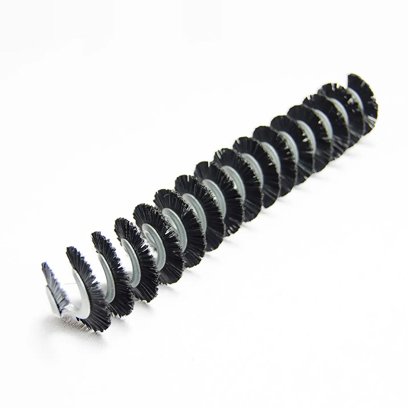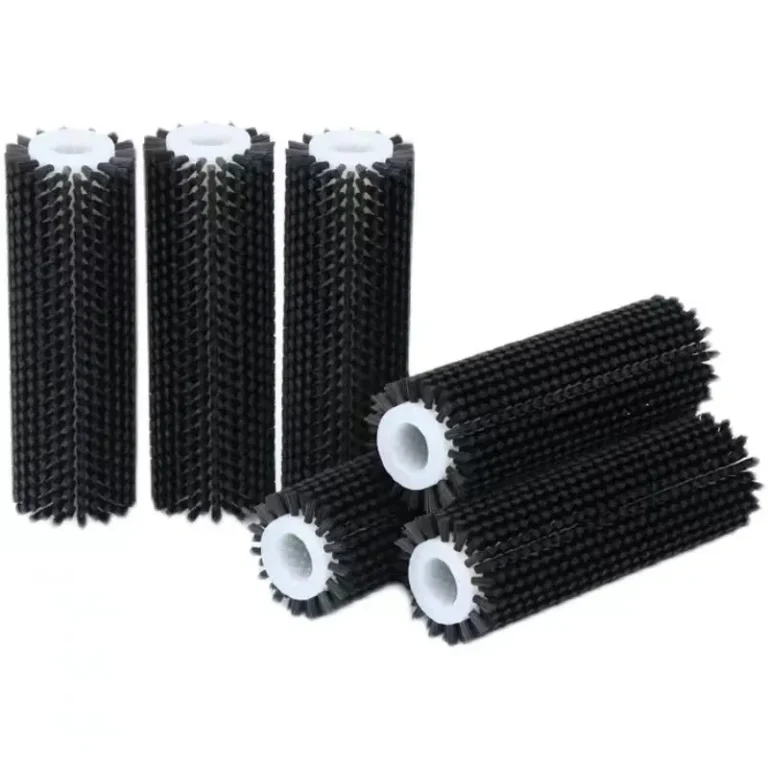
Sealing paths could be wavy profiles, irregular corners, or moving parts. Therefore, ordinary gaskets and rubber strips will not do. They work fine on flat, straight surfaces, but terribly on the surfaces mentioned above. These are the pain points that the customized flexible strip brush seeks to address; it is able to conform to irregular and unpredictable surface geometries while still maintaining uniform contact pressure over time.
In the following sections, we first explain why traditional seals fail on complex contours. Then, we explain how the three main design elements of custom strip brushes lead to a reliable and cost-effective solution.
Why Do Conventional Sealing Products Fail on Complicated Contours?
The basic limitation of all conventional seals, be they rubber gaskets, foam tapes, or rigid weather strips, is that they all depend on static compression against a surface that is made known. Where the sealing path has to make a curve or bend, or where its height is variable, these products will leave gaps in the seal.
Conveyor entries and rotating shafts are examples of dynamic or moving parts, in which friction wears out static seals quickly. Paths in multiple directions are another example where a 3D profile seal cannot simply track a 3D path.
In both scenarios, it’s either the seal releases from the surface or it prematurely wears out. This lets dust in, wastes energy, and also lets pests in — all of which spike maintenance downtime. These failures push the engineers toward an entirely new approach, one that marries controlled flexibility with structural adaptability. And that’s just where a flexible strip brush presents a much better alternative.
Three Key Benefits of Custom Flexible Strip Brushes for Sealing Complex Contours
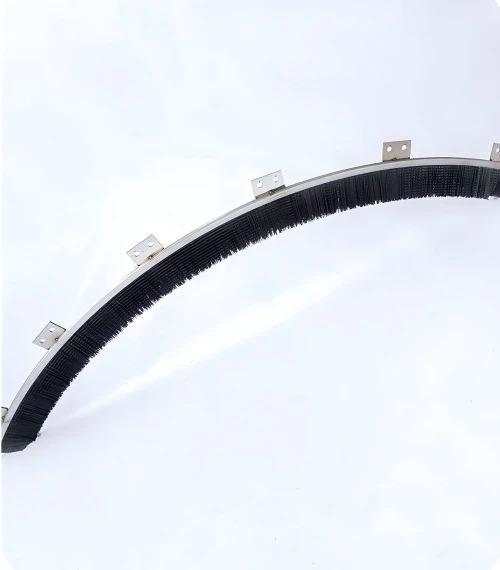
A good Flexible Brush Seal makes contour sealing easy with three design elements that are made to work together: control over bristle material, customization of the metal channel, and selection of the best filament for the purpose.
Controllable Flexible Bristles: Precision Resilience for Every Surface Profile
Flexibility in a strip brush is not merely “soft.” It is the sort of resilience one can control—the bristle bends under pressure to take the shape of the surface and then springs back to its original position when the force is removed. Such cycles of deformation allow for constant sealing against surfaces that may change shape or even move. That, therefore, is an effective Flexible Brush Seal; it responds dynamically rather than resists motion.
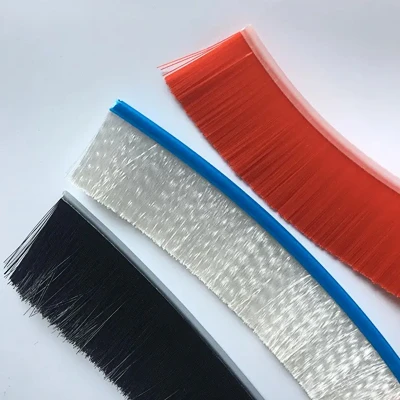
Engineers have control over this by setting three parameters: Material of filament — Each of nylon, polypropylene, sisal, and stainless steel wire comes with a different ratio between stiffness and flexibility. Diameter of filament — Ranging from 0.1 mm to 1.5 mm; thinner filaments give softer compliance, and thicker ones give firmer contact. Packing density — Sealing pressure increases with high density; conformability is better with low density.
A custom flexible strip brush can combine these parameters to self-adapt to wave-shaped panels, stepped joints, and oscillating machine surfaces without undergoing any permanent deformation. For guidance on matching bristle specifications to door applications, practical tips are detailed in the selection and installation guide referenced above.
Custom Metal Channel Base: The Shape You Want, Lower Installation Costs
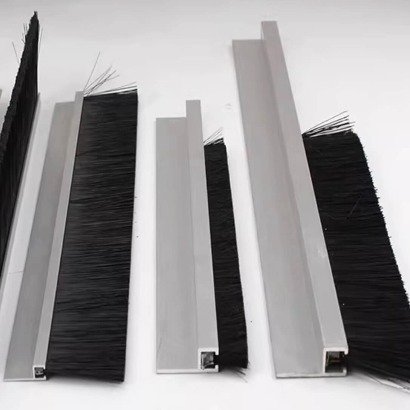
Straight lines are rare in the world of complex shapes. A sealing path might move through 3D space, curving gently, looping back on itself, or even zigzagging or twisting. It’s the metal channel base of the strip brush that determines just how well the brush can stay on these paths. This structural customization is what makes the Industrial Strip Brush for Door Sealing the perfect choice for all serious architectural and industrial work.
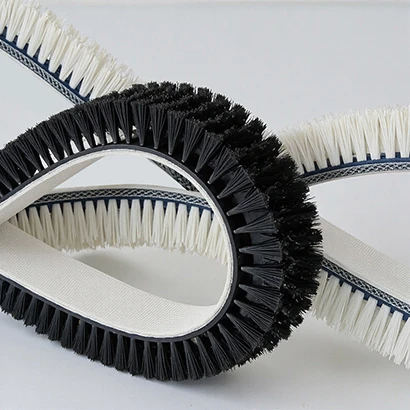
Customization options are as follows:
| Parameter | Available Options | Impact on Performance |
| Channel Material | Galvanized steel, stainless steel, and aluminum alloy | Corrosion resistance, weight, cost |
| Cross-Section Shape | U-channel, H-channel, F-channel, custom profiles | Mounting method, bristle retention strength |
| Bending Radius | From 50 mm to flat straight lengths | Ability to follow tight curves |
| Fabrication Method | Spiral winding, segmented splicing, continuous forming | 3D contour coverage, joint continuity |
It Is an Already Pre-Bent or Spiral-Wound Metal Channel That Comes to the Site for Installation. Technicians Only Fix It Along the Contour Path; No Cut or Bend of Length on Site Is Required. This Approach Will Cut Labor Hours by a Big Margin and Completely Do Away with Fit-and-Trim Cycles Currently Associated with Rigid Seal Installations.
High-Performance Nylon Bristles That Can Be Used In All Works
Nylon (PA6/PA66) is the most general and versatile of all materials of filaments for sealing applications. Use of this in almost every industry can be attributed to a profile of properties that is balanced:
Abrasion-resistant: Can stand up to thousands of door openings and closings without wearing down the bristles.
Temperature Tolerance: Works fine from -40 °C to +100 °C.
Chemical Resistance: Resistant to weak acids, alkalis, and UV degradation.
Additive Compatibility: Manufacturers can add flame retardants, anti-static agents — even hit food-grade with nylon filaments.
More specifically, for door sealing, the nylon bristles block dust, airflow, insects, and light — without scratching the surface of the door. It’s this balance between protection and surface safety that makes the Nylon Bristle Door Brush Seal the top value for most money in commercial and industrial door installations.
For further details on the comparison between the nylon filament grades and their applications, please refer to the technical aspects in the guide for the nylon flexible strip brush.
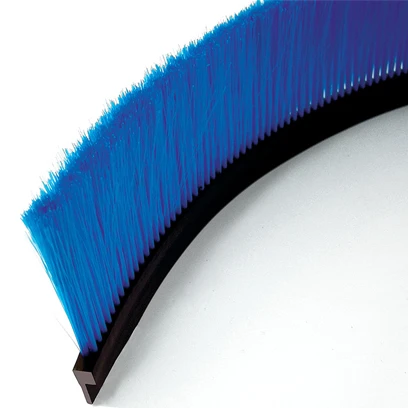
Custom Flexible Strip Brush vs. Traditional Sealing Products
| Criteria | Custom Flexible Strip Brush | Rubber Gasket / Foam Tape |
| Contour adaptability | Conforms to irregular, wavy, and 3D surfaces | Limited to flat or simple curved surfaces |
| Dynamic surface compatibility | Bristles flex and recover continuously | Compresses permanently under repeated motion |
| Installation on complex paths | Pre-shaped metal channel; minimal on-site adjustment | Extensive cutting, bonding, and shimming |
| Lifespan under friction | High — nylon and steel filaments resist abrasion | Low — foam degrades, rubber cracks |
| Range of Customization | Material, diameter, density, and channel shape are all adjustable | Fixed profiles with limited modification |
| Sealing integrity over time | Maintains consistent contact pressure | Loses compression and creates gaps |
A Flexible Brush Seal works well even when the equipment vibrates, shifts, or cycles through temperature changes. This makes it much more effective than rubber gaskets for door protection in high-traffic areas. It also delivers the best balance between resistance to abrasion and protection of the surface—something that foam tapes cannot match.
A weather seal brush is added to harsh-environment scenarios to make it more durable by keeping out dust and moisture even under extreme temperature and wind conditions.
Conclusion
The answer to complex contour sealing lies in a solution that combines adaptive flexibility, structural formability, and material durability — three features that rigid gaskets and foam strips cannot offer simultaneously. It is a specially made flexible strip brush that unites controllable bristle resilience, accurately shaped metal channels, and high-performance nylon filaments in one system, ready for installation. Whether your application has to do with dynamic machinery, heavy door systems, or surface-sensitive components, our custom sealing solutions will reduce the total installed cost while offering superior long-term integrity.
Buyers or purchasing agents seeking sealing solutions for irregular profiles, dynamic equipment, or multi-contour door frames would find the flexible strip brush to be the most reliable and cost-effective option available in the market today.
FAQ
What is the minimum order quantity for custom-shaped flexible strip brushes?
MOQ depends on the complexity of the channel and the specification of the filament. Most manufacturers will accept small trial orders of 50-100 meters for testing and validation. Your chosen supplier of flexible strip brushes will be able to give you the exact MOQ details based on your specific requirements for contours.
Can flexible strip brushes seal gaps on high-speed conveyor entry points?
Yes. The bristles made of nylon or polypropylene and packed at an optimal packing density can deal with dynamic contact sealing continuously as long as the conveyor moves. Such applications require a properly specified Flexible Brush Seal.
How do buyers specify the right bristle diameter for their sealing application?
Measure the gap width and desired compression depth — then, suggest filament diameter and density to hit the target contact pressure. For door-specific requirements, the Nylon Bristle Door Brush Seal comes with pre-engineered specs that make the selection process much easier.
Which industries benefit most from the Industrial Strip Brush for Door Sealing?
It finds applications in automated warehouses, clean rooms, cold storage, elevators, and general manufacturing and other industrial applications where the integrity of the door seals directly affects energy efficiency and environmental control. The Industrial Strip Brush for Door Sealing performs uniformly well in all such stringent environments.