Choosing the right Spiral tube Brush for lab glassware — what additional factors are there? Bristle material, tip design, stainless steel core wire, and the right sizing tips for custom sizing work.
The right Spiral tube Brush removes all dirt, thus protecting fragile glass and ensuring no cross-contamination between tests. The wrong one would leave the inner walls dusty and, in addition to shedding some fibers into the samples, would get corroded by a single soak of acid. For laboratory procurement teams, this should be a selection process far beyond just choosing a brush that “looks like it fits.”
Material, tip construction, core wire composition, and dimensional accuracy of the bristle determine whether a laboratory spiral brush will work well or bring new problems into play. This paper will discuss these factors in detail so that purchasing managers and laboratory supervisors can get the right brush on the first order.
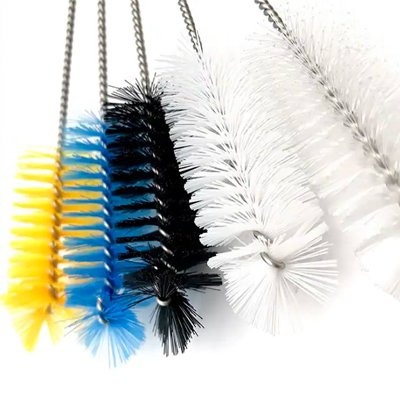
Risks of Choosing the Wrong Laboratory Spiral Brush
Most labs realize problems after the damage has occurred. Common results include:
- Scratched glassware — Hard bristles gouge the borosilicate walls, creating micro-cracks through which contaminants get trapped.
- Chemical contamination — A core wire of carbon steel will rust in acidic wash solutions; iron ions get deposited into the reactions that follow.
- Incomplete cleaning — An undersized brush will merely spin freely within the vessel without coming into contact with the walls; hence, stubborn residues will be left behind.
- Breakage — An exposed metal tip punctures thin-walled flasks during routine scrubbing.
This guide should be reviewed by anyone who has experienced these issues, as well as our guide on common problems with test tube brushes and their solutions, for further steps of troubleshooting. Practically all these risks are eliminated by paying attention to the four factors below.
1. Match Bristle Material to Type of Residues and Temperature of Cleaning
The material of the bristle is the most important decision to make. Different types of filaments are required for different experimental residues and wash temperatures. The table below shows, in summary, the best use case for each:
| Bristle Material | Best Application | Temperature Limit | Chemical Resistance |
| Nylon (PA6.6/PA6.12) | Routine water-based and mild chemical cleaning | Up to ~120°C | Good against dilute acids, alcohols, and most solvents |
| Natural Animal Hair | Ultra-delicate, thin-walled, high-value glassware | Up to ~80°C | Low: avoid strong acids and bases |
| Stainless Steel Wire | Metal tubing, sintered deposits, baked-on residue | Up to ~500°C+ | Excellent against most chemicals |
| Copper Wire | Static-sensitive environments, metal tubes | Up to ~300°C | Moderate: attacked by ammonia and strong acids |
| Acid-Resistant Specialty Fiber (PVDF / PTFE) | Strong acid / strong alkali wash environments | Up to ~200°C | Exceptional |
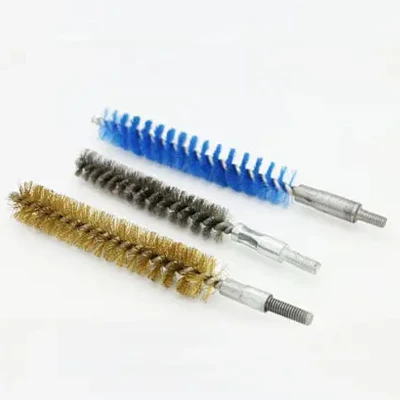
In general, glassware like beakers, Erlenmeyer flasks, and graduated cylinders can be cleaned of most water-based residues with safety and efficiency by the use of a Nylon Wire Tube Bottle Cleaning Spiral Brush. Its filaments are soft but resilient, and they take the shape of curved glass surfaces without scratching.
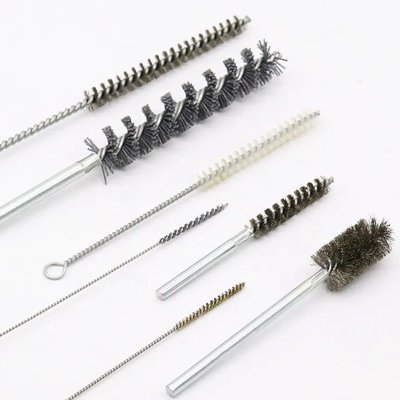
In labs working with strong acids like HCl or HNO₃, they need to specify specialty acid-resistant filaments such as PVDF. This is because standard nylon degrades very rapidly in concentrated acid baths. For more on how different filaments go with different tube materials, see our piece on the structure and materials of tube cleaning brushes.
Scrubbing power is delivered by stainless steel wire bristles — they should not come in contact with regular borosilicate glass. Reserve this model only for metal lab piping or very fouled metal vessels where some abrasion is acceptable. Use the Spiral Wire Brush Stainless Steel Internal Cleaning model on metal lab piping or very fouled metal vessels where some abrasion is acceptable.
2. Folded-Tip Design for Scratch Prevention on Thin-Wall Glass
Even the softest bristles cannot protect the glass if a bare metal wire tip sticks out from the brush head. A single exposed end can score a round-bottom flask in one stroke.
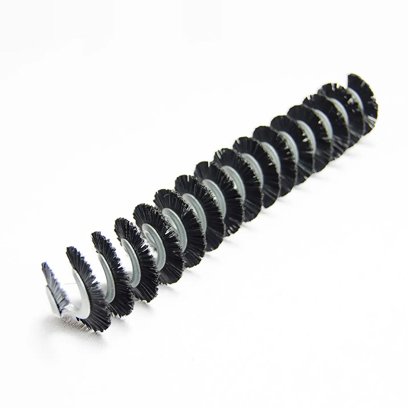
The design of the spiral tube Brush has a tip of single or double fold by bending the core wire back on itself and then wrapping it inside the bundle of bristles. This construction ensures that:
- At the brush end, there is no direct contact between metal and glass.
- Allows safe cleaning of closed-bottom vessels such as test tubes and volumetric flasks.
- Reduces the risk of injury to the operator while scrubbing manually.
Always ask for a close-up photo or a cross-sectional diagram of the fold at the tip when evaluating suppliers. That detail is as important in a Highly Efficient Cleaning Laboratory Test Tube Brush as the quality of the bristles. For more practical selection guidance, our article on choosing the best brush for tube cleaning delves into tip construction to a greater degree.
3. 304/316 Stainless Steel Spiral Core to Eliminate Reagent Cross-Contamination
The spiral core wire holds every bristle and provides the brush with the necessary structural rigidity. A more serious problem arises if the core corrodes, in which case it would be unacceptable, as it would mean direct contamination of the cleaning solution with metal ions, a risk that cannot be accepted in a pharmaceutical or analytical laboratory.
Recommended core wire choices for laboratory environments:
- SS304 — Strong corrosion resistance, high tensile strength; good for most general laboratory cleaning routines.
- SS316 — Molybdenum means even better resistance to chlorides and strong acids; top pick for pharmaceutical, biological, and trace-analysis labs.
Both grades resist rusting after prolonged immersion in detergent baths, solutions of chromic acid cleaning, and ultrasonic cleaning tanks. In contrast, the carbon steel and galvanized wire cores rust within days and should never be used in a laboratory setting. For more on how core wire material impacts cleaning performance across different tube systems, check out the benefits of tube cleaning brushes in industrial and laboratory applications.
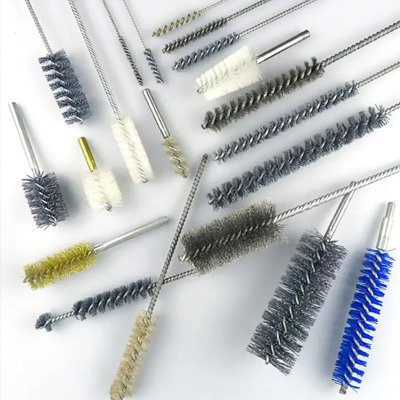
4. Custom Sizing for a Perfect Fit with Every Glassware Interior
The inside diameter of the vessel being cleaned must be closely matched by a Spiral tube Brush; if it is too loose, the bristles will not touch the wall of the vessel, while if it is too tight, there will be too much friction, and this can damage the glass or even deform the brush.
Parameters to check with the manufacturer:
- Bristle outer diameter (OD) — It should be more than the inner diameter of the vessel by about 5–10% to ensure proper contact of the bristles.
- Length of the brush — It should touch the bottom of the deepest vessel without letting the operator’s grip go outside the opening.
- Core wire diameter — Thick cores are for resistance in long tubes; thin ones are for flexibility in curved glassware.
- Overall handle length — It should match the length of the arms for tall cylinders and deep flasks.
Experienced lab managers provide the manufacturer with a complete vessel inventory — inner diameter, depth, and neck width for each item — before they can close out any order. This will put a stop to re-orders that will cost more than the brush and ensure that all glassware gets a match with the brush.
Compare the Performance of Materials of the Bristle and Core Wire of the Laboratory Spiral Brush
| Property | Nylon Bristle + SS304 Core | Animal Hair + SS304 Core | SS Wire Bristle + SS316 Core | PVDF Bristle + SS316 Core |
| Glass Safety | ★★★★☆ | ★★★★★ | ★☆☆☆☆ | ★★★★☆ |
| Scrubbing Power | ★★★★☆ | ★★☆☆☆ | ★★★★★ | ★★★☆☆ |
| Acid/Alkali Resistance | ★★★☆☆ | ★☆☆☆☆ | ★★★★★ | ★★★★★ |
| Heat Tolerance | ★★★☆☆ | ★★☆☆☆ | ★★★★★ | ★★★★☆ |
| Cost | Low-Medium | Medium | Medium-High | High |
Frequently Asked Questions
Is there a Spiral tube Brush that can safely clean both glass and metal lab tubes?
Not really. For the glass, it should be soft nylon or natural hair bristles, and for the metal tubes, it should be stainless steel wire; using the same brush for both risks scratching the glass or leaving the metal tube under-cleaned.
What is the general replacement period for spiral brushes in a laboratory?
Renew them when the bristles fan out, become very thin, or start shedding filaments. For most labs, this could be anywhere between three and six months, depending on how often the tools are used daily and the type of chemicals they come into contact with.
What is the minimum order quantity for custom Spiral tube Brushes to fit specific glassware sizes?
MOQ depends on the manufacturer. Most reputable brush suppliers would take such orders for 100–500 pieces, and they usually allow customization of diameters, lengths, and bristle types for special requirements on laboratory apparatus.