A production line stops because a brush wears out three weeks early. The replacement does not fit. The mounting holes are off by two millimeters, the bristles are too short to make contact, and the backing channel is the wrong profile. The maintenance team spends the next four hours improvising a workaround while the line sits idle.
This happens more often than most plant managers want to admit. The root cause is rarely a bad product. It is a bad measurement. Conveyor brush strips look simple: a channel, some filament, a retaining wire. But a working brush strip depends on six to eight dimensional variables, and getting any one of them wrong means the brush will either fail to install, fail to make contact, or fail far sooner than it should.
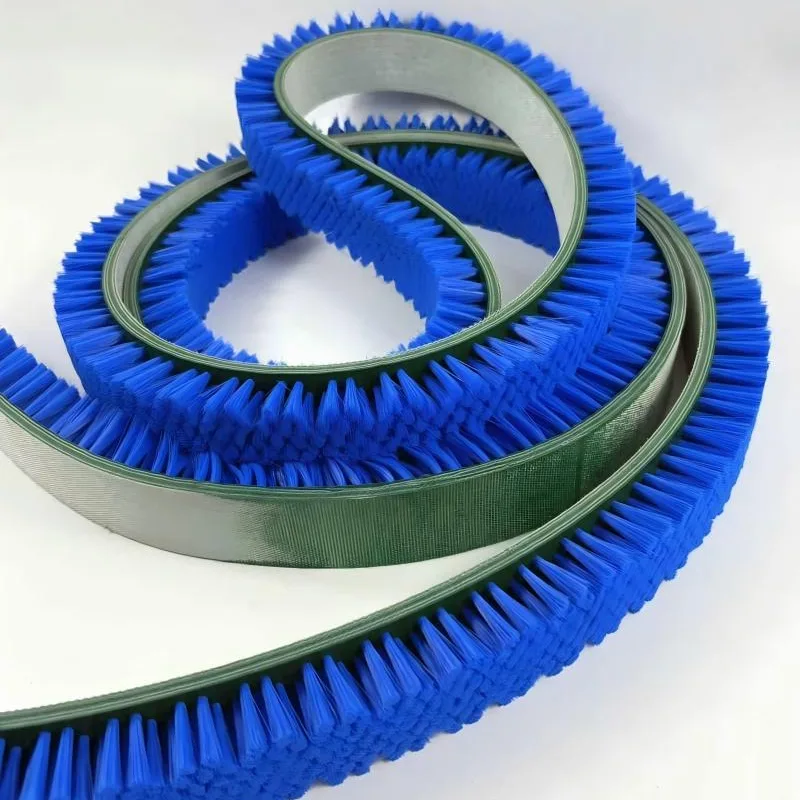
Sizing a custom conveyor brush strip requires measuring five core dimensions — belt width, bristle trim height, overall backing height, filament diameter, and base profile — and matching those dimensions to the conveyor’s speed, material type, and environmental conditions. A correctly sized brush strip maintains consistent contact pressure across the full belt surface, compensates for belt wear over time, and integrates with the existing mounting hardware without modification.
The decision tree for sizing is straightforward. Start with the conveyor itself: its width, its speed, and what travels on it. From those three parameters, every other dimension follows. The filament material, the backing type, and the mounting style are all downstream choices that depend on the numbers you measure first. This guide walks through each dimension in order, so that the next time a conveyor brush strip needs replacing, the replacement fits on the first try.
What Dimensions Define a Conveyor Brush Strip
A conveyor brush strip is defined by six primary dimensions: overall length, brush face width, bristle trim height, overall backing height, filament diameter, and base width. Secondary dimensions include bristle density, filament pattern, and trim angle. All of these must be specified before manufacturing can begin.
Overall Length and Brush Face Width
The overall length of a conveyor brush strip must match the conveyor belt width, with an additional allowance for mounting brackets on either end. Most strip brushes ship in standard lengths of 1 to 3 meters, though custom lengths can run up to 6 meters for wide-belt conveyors used in mining or aggregate processing.
The brush face width is the section that actually contains bristles. This is not the same as the overall length. A 1.5-meter brush strip may have only 1.4 meters of active bristle face, with 50 mm of bare backing on each end reserved for clamping or bolting. When measuring a worn brush for replacement, measure both values. Ordering by overall length alone can produce a brush that is too short or too long at the mounting points.
For conveyors that run multiple parallel brush strips — common in food processing and textile lines — each brush section should be measured independently. Belt tracking can shift over time, and a brush that was perfectly centered at installation may now sit 3 mm to one side. Measuring each position separately accounts for this drift.
| Conveyor Type | Typical Belt Width | Recommended Brush Length Tolerance |
|---|---|---|
| Light-duty package handling | 300–800 mm | Belt width + 20–40 mm |
| Food processing | 400–1200 mm | Belt width + 30–50 mm |
| Heavy industrial / mining | 800–2400 mm | Belt width + 50–100 mm |
| Specialty / narrow transfer | 100–300 mm | Belt width + 10–20 mm |
Bristle Trim Height
Trim height is the length of the bristle from the top of the backing to the bristle tip. It determines how much pressure the brush applies to the belt surface and how much wear it can absorb before replacement.
A bristle that is too short will either fail to make contact with the belt or lose contact within weeks as the tips wear down. A bristle that is too long will flex excessively at speed, reducing cleaning effectiveness and causing uneven wear across the brush face.
For most cleaning applications, the trim height should allow 2–5 mm of bristle deflection at the contact point. This range is sometimes called the “interference” or “compression depth.” It provides enough pressure to dislodge debris without dragging on the belt or generating excess friction heat.
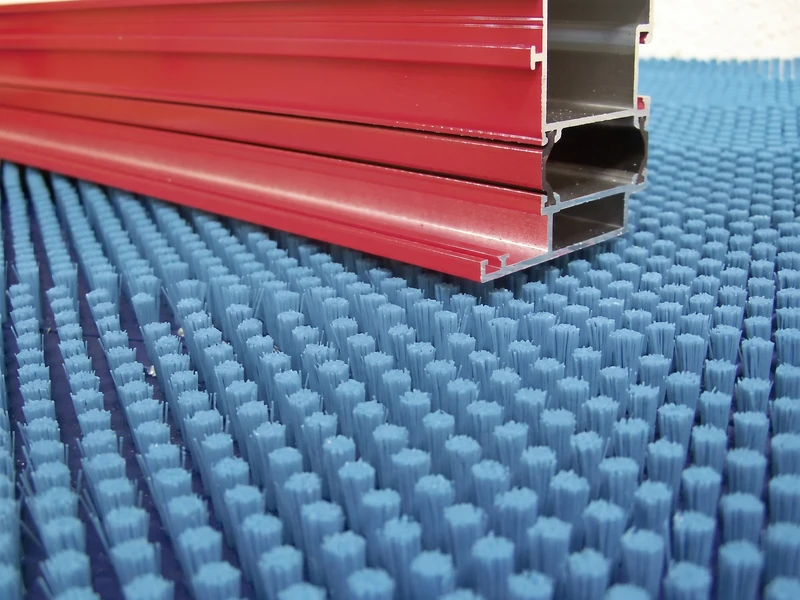
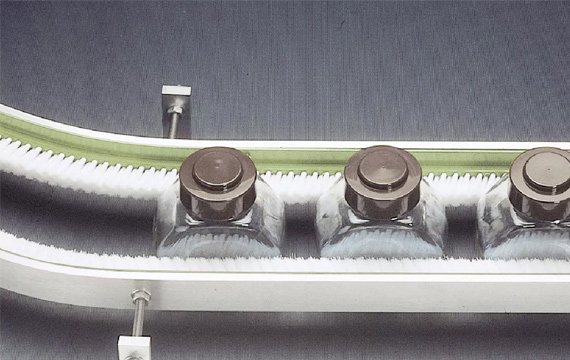
In conveying applications — where the brush strip supports or moves product rather than cleaning — the trim height must match the product height profile. A flat belt brush configuration carrying glass bottles needs a different trim than one guiding cardboard cartons. The bristle should extend 10–15 mm above the product’s tallest point to prevent tipping.
| Application | Recommended Trim Height | Compression Depth |
|---|---|---|
| Light belt cleaning | 25–50 mm | 2–3 mm |
| Heavy debris removal | 50–100 mm | 3–5 mm |
| Product conveying/guiding | 20–40 mm | N/A (support, not compression) |
| Gap sealing/skirting | 40–80 mm | 0–1 mm |
Overall Backing Height
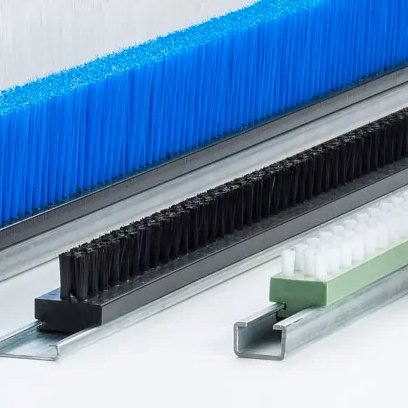
Backing height is the vertical dimension of the metal or plastic channel that holds the bristles. It matters because the brush strip slides into a mounting holder, and the holder’s internal slot height must match the backing height.
Standard backing heights range from 3 mm to 12 mm. Metal-backed strips — typically galvanized or stainless steel — use U-channel profiles with backing heights of 4 mm, 5 mm, 6 mm, 7 mm, 8 mm, or 10 mm. PVC-backed strips, which are lighter and more flexible, use backing heights of 4 mm to 8 mm.
Before ordering a replacement, pull the old brush out of its holder and measure the backing height with calipers. Do not rely on the holder’s label or the original equipment specifications. Holders can deform over time, especially aluminum holders in high-vibration environments. A holder that was machined for 6 mm backing may now accept 6.3 mm. If the measurement is off by 0.5 mm or more, the new brush may be too loose or too tight to install.
Filament Diameter
Filament diameter is measured in millimeters or thousandths of an inch and typically ranges from 0.10 mm to 1.50 mm for synthetic filaments. Finer diameters (0.10–0.30 mm) suit light dusting and polishing. Medium diameters (0.30–0.60 mm) work for general-purpose cleaning. Coarse diameters (0.60–1.50 mm) handle heavy debris removal and aggressive scrubbing.
The filament diameter also affects the brush’s wear rate. A 0.20 mm nylon filament on a conveyor running at 2 meters per second will wear down roughly twice as fast as a 0.40 mm filament in the same position. However, the thicker filament exerts greater mechanical force on the belt surface, which can damage delicate belt coatings or scratch conveyed products.
Matching filament diameter to the belt brush material and the belt surface is a balancing act. For urethane-coated belts in food plants, 0.25–0.35 mm nylon provides enough cleaning force without abrading the coating. For rubber belts in mining, 0.50–0.80 mm nylon, or even abrasive-impregnated filament, handles heavy loading.
| Filament Diameter (mm) | Cleaning Aggressiveness | Typical Belt Type | Wear Life |
|---|---|---|---|
| 0.10–0.20 | Very light (polishing) | Thin PVC, coated fabric | 3–6 months |
| 0.25–0.35 | Light to medium | Urethane, food-grade | 6–12 months |
| 0.40–0.60 | Medium to heavy | Standard rubber | 9–18 months |
| 0.70–1.50 | Heavy/abrasive | Thick rubber, steel cord | 12–24 months |
Base Width
Base width is the thickness of the backing channel — how wide it measures at its base where it sits in the holder. Standard values are 3.0 mm, 3.8 mm, 4.8 mm, 6.3 mm, and 8.0 mm for metal-backed brushes. PVC-backed brushes commonly use 5 mm or 8 mm base widths.
The base width must match the holder slot width. This is the dimension most likely to be measured incorrectly because worn brushes lose material from the backing edges, making the base appear thinner than it actually is. Always measure the holder slot directly rather than the old brush base. A feeler gauge is more reliable than calipers for this measurement since the slot is a narrow gap.
Bristle Density and Pattern
Bristle density — the number of filament tufts per linear meter — determines how much of the brush face actually contacts the belt. Dense packing (80–120 tufts per meter) provides more aggressive cleaning and longer wear life but costs more and generates more friction. Sparse packing (40–60 tufts per meter) suits light dusting and conveying applications where minimal belt drag is the priority.
Filament pattern also matters. Straight-set bristles are perpendicular to the backing and provide uniform contact. Angled or herringbone patterns direct debris laterally toward the belt edge, which helps on conveyors that accumulate material in the center. Crimped filaments interlock with each other, creating a denser brush face that holds its shape better under compression. The right pattern depends on what the conveyor cleaning brush is supposed to do: remove, redirect, or contain.
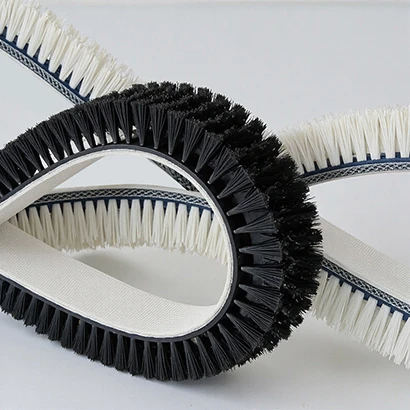
How Conveyor Speed Affects Sizing Decisions
Conveyor speed dictates the minimum filament diameter and the maximum trim height. Faster belts need thicker filaments to resist bending forces and shorter trim heights to reduce flutter. A brush sized for a 1 m/s conveyor will fail within days on a 3 m/s line.
Speed and Filament Dynamics
At belt speeds above 2 meters per second, centrifugal and aerodynamic forces start to lift the bristle tips away from the belt surface. This phenomenon, called “bristle lift” or “tip flutter,” reduces cleaning pressure and creates uneven wear patterns. The fix is to either increase the filament diameter to add stiffness or decrease the trim height to shorten the lever arm.
A practical rule: for every 1 m/s increase in belt speed above 2 m/s, increase the filament diameter by 0.10 mm or decrease the trim height by 10 mm. A brush that runs a 40 mm trim at 0.35 mm filament diameter on a 2 m/s conveyor needs either a 30 mm trim or a 0.45 mm filament at 3 m/s to maintain the same contact pressure.
| Belt Speed (m/s) | Minimum Filament Diameter (nylon) | Maximum Trim Height |
|---|---|---|
| 0.5–1.0 | 0.20 mm | 80 mm |
| 1.0–2.0 | 0.30 mm | 60 mm |
| 2.0–3.0 | 0.40 mm | 45 mm |
| 3.0–4.0 | 0.50 mm | 35 mm |
Motorized Brush Rolls vs. Passive Strip Brushes
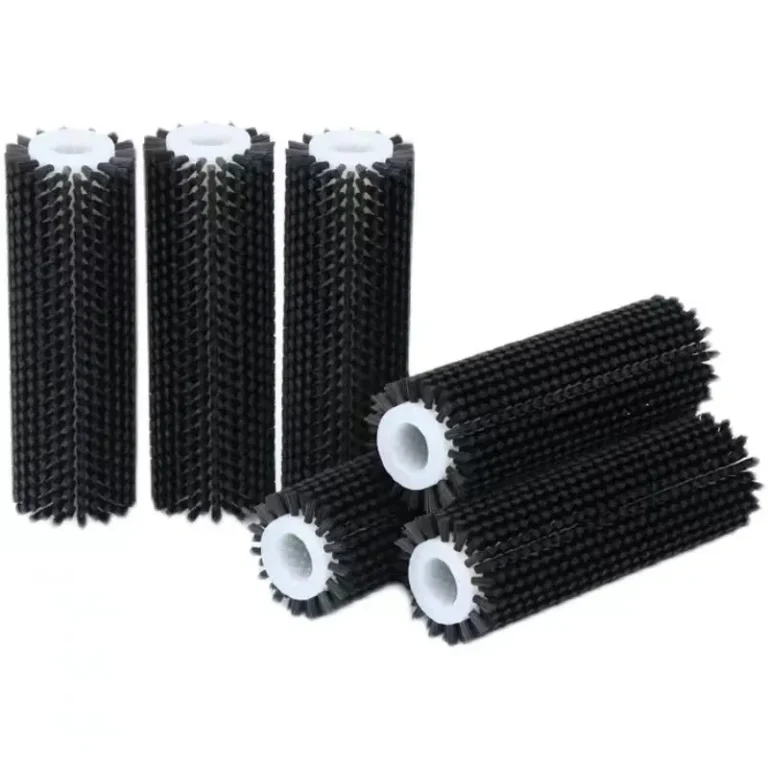
A motorized brush roll spinning against the belt direction applies far more cleaning force than a passive strip brush. Strip brushes rely on belt motion and bristle deflection alone. When a passive strip brush cannot deliver enough cleaning force at the available belt speed, an upgrade to a motorized cylinder brush becomes necessary. The sizing logic stays similar — diameter, face width, shaft diameter — but the driving force is independent of belt motion, which changes the minimum filament requirements.
Matching Filament Material to Operating Conditions
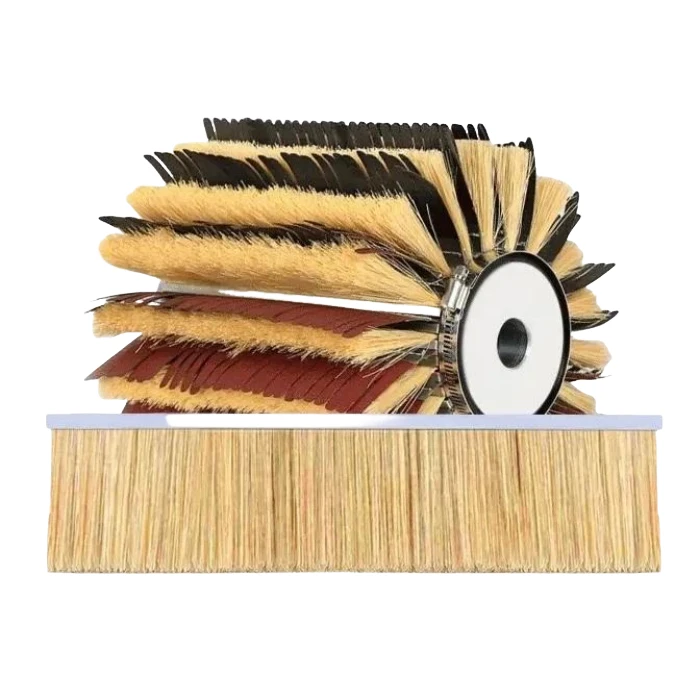
Nylon (PA6 and PA66) is the default filament for general-purpose conveyor brush strips. Polypropylene replaces nylon in wet or chemically exposed environments. Abrasive nylon handles deburring and surface conditioning. Natural fibers handle static-sensitive and delicate product lines.
Nylon filament strip brushes dominate the industrial brush maintenance space because they deliver reliable performance with balanced cost efficiency, wear resistance, and temperature tolerance. PA66 withstands continuous operation at 120°C and intermittent exposure up to 150°C. PA6 is slightly softer, with better impact absorption, and works well for conveying applications where the brush contacts the product rather than the belt.
Polypropylene resists most acids, alkalis, and industrial cleaning chemicals that degrade nylon. Its lower water absorption (under 0.01% versus nylon’s 2–9%) keeps bristle stiffness consistent in wet environments. The trade-off is lower abrasion resistance. PP filaments wear about 30–40% faster than nylon in dry, abrasive conditions.
Abrasive nylon filaments embed silicon carbide or aluminum oxide grit into the nylon matrix. These filaments cut rather than wipe. They remove scale, rust, paint, and burrs from metal surfaces and can replace a separate grinding or deburring station on the line. Grit sizes range from 46 (coarse, aggressive) to 1000 (fine, polishing). Sizing an abrasive brush strip adds one more variable: the grit mesh number, which determines the surface finish.
For strip brush applications in concrete block plants and similar abrasive environments, nylon filaments reinforced with abrasive grit provide the necessary wear life. Standard nylon filaments in these conditions may last only weeks before losing effective contact pressure.
| Filament Material | Max Temp | Water Absorption | Best Application | Relative Cost |
|---|---|---|---|---|
| Nylon PA66 | 120°C | 2.5% | General cleaning, dry environments | Medium |
| Nylon PA6 | 100°C | 8.5% | Impact conveying, light cleaning | Low |
| Polypropylene | 80°C | <0.01% | Wet, chemical, food processing | Low–Medium |
| Abrasive Nylon | 120°C | 2–3% | Deburring, scale removal | High |
| Natural Fiber (Tampico) | 60°C | High | Polishing, static-sensitive | Medium–High |
Measuring for a Replacement Brush Strip
The most reliable replacement measurement comes from the mounting hardware, not the worn brush. Measure the holder slot width, holder slot depth, distance from holder to belt surface, and belt width. Then subtract the desired compression depth from the holder-to-belt distance to calculate trim height.
Step-by-Step Measurement Process
Take measurements in this order:
Measure the belt width at three points — left, center, right — and use the widest measurement. Belts stretch unevenly over their service life.
Measure the holder slot width with a feeler gauge. Insert progressively thicker leaves until a snug fit is found. This is the base width
Measure the holder slot depth with the depth probe on a set of calipers. This gives the minimum backing height.
Measure the distance from the holder face to the belt surface with the conveyor stopped and the belt tensioned to operating specifications
Subtract 2–5 mm from the holder-to-belt distance. This is the target trim height, including the compression allowance.
Record the overall length required, including any mounting extensions.
A common mistake is measuring the old brush’s bristles rather than the gap the brush fills. Worn bristles are shorter than the original specification. If the old brush’s trim height is 38 mm and the holder-to-belt gap is 42 mm, the correct replacement trim height is 42 mm minus 2–3 mm of compression, or 39–40 mm. Ordering a 38 mm replacement based on the worn brush will produce a brush that applies less pressure than the original design intended.
When to Add Extra Bristle Length
Some applications benefit from adding 5–10 mm of extra trim height beyond the calculated value. The extra length serves as a wear reserve — as the tips erode over months of service, the brush maintains contact longer before replacement. This is common in continuous-process lines where unplanned downtime for brush replacement costs more than the brush itself. The trade-off is a slightly higher initial bristle deflection, which increases friction and power draw.
Common Sizing Mistakes and Their Consequences
Ordering the wrong brush strip size produces predictable failures. Each mistake has a specific symptom that maintenance teams learn to recognize.
A brush that is too short will leave an uncleaned strip along one or both edges of the belt. A brush that is too long will overhang the belt and catch on adjacent machinery. Incorrect trim height is the most common sizing error and produces either insufficient cleaning pressure or excessive belt wear.
| Mistake | Symptom | Root Cause | Prevention |
|---|---|---|---|
| Brush too short | Uncleaned belt edges | Measured worn belt, not new belt spec | Add 30–50 mm to belt width measurement |
| Trim too short | No contact after 2–4 weeks | Failed to account for wear-in period | Add 5 mm wear allowance to calculated trim |
| Trim too long | Bristle flutter, uneven wear | Trim exceeds speed rating for filament diameter | Reduce trim or increase filament diameter |
| Wrong base width | Brush rattles or jams in holder | Measured old brush base, not holder slot | Measure holder slot with feeler gauge |
| Wrong backing height | Brush rocks or tilts in holder | Used visual match instead of caliper measurement | Use caliper depth probe on holder |
| Wrong filament diameter | Premature wear or belt scoring | Copied existing spec without reviewing conditions | Match filament diameter to belt speed and surface |
Ordering a Custom Conveyor Brush Strip
A custom brush order form typically asks for eight to twelve data points. The more complete the specification, the fewer back-and-forth emails with the manufacturer’s engineering team. A block machine strip brush built for the abrasive conditions of a concrete plant needs a different specification package than a food-grade cleaning brush, but the dimensional data fields are the same.
| Specification Field | Example Value | How to Obtain |
|---|---|---|
| Overall Length | 1250 mm | Measure belt width + bracket allowance |
| Brush Face Width | 1200 mm | Length minus mounting areas |
| Bristle Trim Height | 45 mm | Holder-to-belt minus compression |
| Overall Backing Height | 6.0 mm | Caliper measurement of holder depth |
| Base Width | 4.8 mm | Feeler gauge in holder slot |
| Filament Material | Nylon PA66 | Match to temperature and chemical exposure |
| Filament Diameter | 0.40 mm | Match to belt speed and cleaning force |
| Backing Material | Galvanized steel | Match to environment (stainless for food/wet) |
| Mounting Style | Slide-in holder | Based on existing hardware |
A few additional fields that speed up manufacturing quotes:
- Bristle density (tufts per meter, typically 60–120)
- Filament pattern (straight, angled, herringbone, crimped)
- Trim angle (flat, angled, or V-cut)
- Antistatic or conductive requirements
- FDA or EU food-contact compliance needs
Summary
A conveyor brush strip fails early for one of two reasons: the wrong material or the wrong size. Material selection gets more attention because the differences between nylon, polypropylene, and abrasive filament are visible and easy to discuss. Sizing errors are quieter. They show up as a brush that almost fits, or makes contact for two weeks and then stops, or wears a groove into one side of the belt while the other side stays clean.
The five measurements that matter are belt width, trim height, backing height, filament diameter, and base width. Get those right, and the brush will install, make contact, and wear evenly. Everything else — density, pattern, material grade — is optimization. Optimization matters for service life and performance, but it cannot fix a brush that does not fit the machine it was ordered for.
Frequently Asked Questions
How often should conveyor brush strips be replaced?
Replacement intervals depend on belt speed, loading, and filament material. Light-duty nylon brushes on slow conveyors last 12–18 months. Brushes on high-speed, heavily loaded belts in abrasive environments may need replacement every 3–6 months. The practical trigger for replacement is when bristle trim height wears below the point where 2 mm of compression is no longer possible. At that point, cleaning effectiveness drops sharply.
Can I cut a standard-length brush strip to fit my conveyor?
Metal-backed strip brushes can be cut to length with a hacksaw or abrasive cutoff wheel. PVC-backed brushes can be cut with heavy-duty shears or a utility knife. After cutting, file or deburr the cut edges to prevent the backing from jamming in the holder. Cutting a brush shorter is always easier than extending one, so order long and trim to fit when the exact length is uncertain.
What is the difference between a strip brush and a cylinder brush for conveyor cleaning?
A strip brush is a linear brush mounted in a stationary holder. The belt moves against it. A cylinder brush is a rotating brush driven by its own motor, spinning against the belt direction. Cylinder brushes apply more cleaning force and work on slower belts or belts with deeply textured surfaces. Strip brushes are simpler, cheaper, and require no power source or drive train. The choice between them comes down to how much cleaning force the application needs and whether passive contact is sufficient.