Choosing the Right Filament Material
Selecting the right filament for your belt brush isn’t just about chemical resistance on paper — it’s about matching material performance to your actual operating conditions: chemical concentration, temperature range, contact duration, and cleaning frequency.
Choosing a filament rated for mild detergents in a strong-acid environment leads to premature wear, more frequent replacements, and higher long-term costs, while over-specifying (e.g., PTFE-blended filament for simple water rinse tasks) adds unnecessary expense.
Buyers should start by identifying their harshest exposure condition — not the average one — since filament degradation is typically driven by peak chemical concentration and temperature spikes rather than everyday use.
For facilities running mixed processes (e.g., alkaline cleaning followed by acid rinse), a belt brush built with PPS or PPA/PTFE-blended filament often provides the broadest safety margin, reducing the need to stock multiple brush types.
Our team works directly with procurement and maintenance teams to map filament selection to their specific process chemistry, helping customers balance service life against unit cost rather than defaulting to the most resistant — and most expensive — option by default.
Common Pain Points When Belt Brushes Fail in Chemical Environments
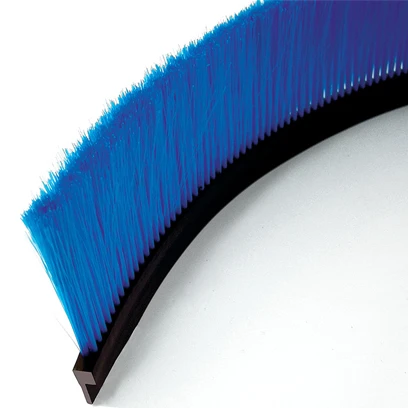
Chemical plants, food-processing lines, and electronics-washing systems all contend with the same recurring issue: belt brush wear out prematurely. Their filaments stiffen, bristles can fall into the product, and the base strips may crack or come apart. Any of these failures can halt production, introduce a contamination risk, and lead to another purchase order.
Years of reviewing procurement decisions in different industries have exposed three recurring mistakes. A more grounded way of choosing materials can help avoid all three.
1. Don’t Rely Solely on Material Datasheets
A datasheet can provide useful information without telling the whole story. Buyers may scan a chart, see “resistant to acids,” and place an order. What it rarely reveals is how concentration, operating temperature, and contact duration interact.
Nylon 6.12, for instance, can withstand diluted alkaline detergents at room temperature. But once the temperature rises above 60°C—or the material remains soaked for longer—hydrolysis accelerates. A Belt Brush may therefore work extremely well in one plant and fail within weeks in another using the same chemical at higher temperatures.
Before a spec is finalized, three questions matter more than any datasheet:
- What chemical concentration is actually present on the line?
- What is the highest surface temperature reached during operation?
- How long does the brush remain in contact with the medium?
2. Avoid Both Extremes: Overpaying and Underpaying
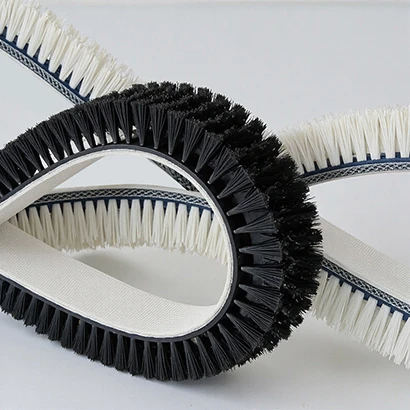
Premium filaments such as PPS and PPA offer excellent chemical stability, but they come at a steep price. For light-duty cleaning agents or diluted weak acids, that performance is unnecessary. A well-built Nylon Flat Belt Brush for Cleaning and Conveying can handle these applications reliably at a fraction of the cost.
At the low-cost end of the market, inexpensive brushes may seem attractive, but the savings can disappear over time. They often require replacement more frequently, create unexpected downtime, and may shed bristles into food, pharmaceuticals, or electronics. A contamination recall can cost far more than the brush itself.
A sensible middle ground is:
| Filament Material | Chemical Resistance | Temperature | Application | Service Life |
|---|---|---|---|---|
| Nylon 6 | Good — water, mild detergents | Up to ~120°C | General washdown, food-contact & mild cleaning lines | 6–12 months |
| Nylon 6.12 | Moderate — diluted weak acids (<10%) | Up to ~130°C | Light acid exposure, industrial rinse environments | 4–8 months |
| PP (Polypropylene) | Excellent — acids/alkalis, detergents | Up to ~80°C | Acid/alkali tank cleaning, chemical washdown | 4–8 months |
| PPS (Polyphenylene Sulfide) | Excellent — strong alkalis, hot solvents | Up to ~200°C+ | High-temp solvent lines, alkaline processing | 8–14 months |
| PPA / PTFE-blended | Outstanding — concentrated acids, high temp | Up to ~260°C | Concentrated acid handling, extreme chemical environments | 6–12 months |
3. Filament & Base: Both Matter
Even chemically resistant bristles offer little protection once the base strip begins to corrode. Stainless-steel channels hold up against most acids, but chlorides can attack 304-grade metal aggressively. Galvanized steel dissolves in alkaline cleaners, and aluminum reacts with strong bases.
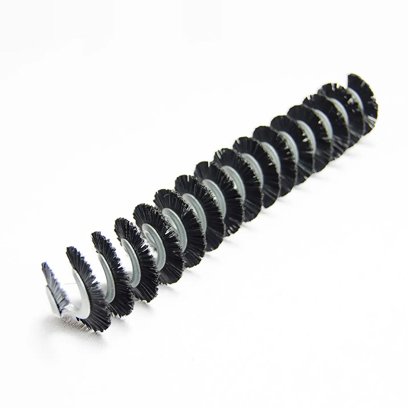
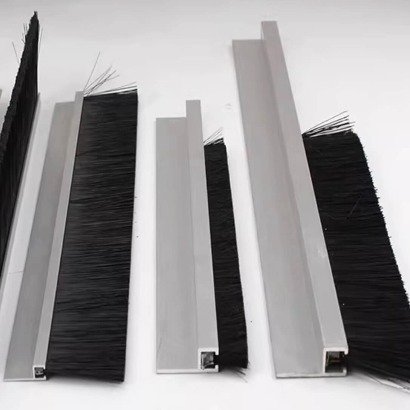
For sealing and short-term chemical contact, a Flexible Strip Brush with anodized aluminum backing works well. Where heavy chemical washdown is involved, choose a Conveyor Brush Strip with a 316 stainless or PP-encased channel base; this helps prevent delamination and keeps rust from entering the process.
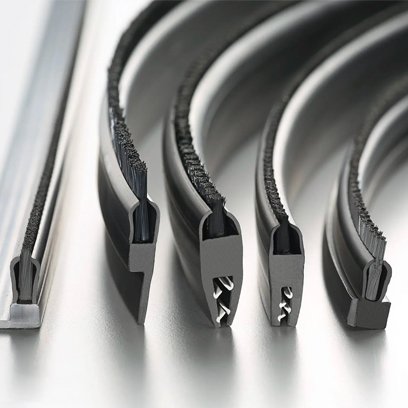
Base failure modes most often reported at customer sites:
- Thermal cycling can lead to cracks along the channel edge.
- Rust bleed may develop in mild-steel channels, contaminating the belt surface.
- Exposure to solvents can weaken the adhesive that joins the bristle bundle to the base.
Comparison of Mainstream Belt Brush Materials
The table is based on field data from cleaning, conveying, and sealing applications. Although it does not replace on-site testing, it provides procurement teams with a defensible starting point.
| Material | Acid Resistance | Alkali Resistance | Solvent Resistance | Max Temp | Relative Cost |
|---|---|---|---|---|---|
| PP (Polypropylene) | Excellent | Excellent | Fair | 80°C | Low |
| Nylon 6 | Fair | Good | Good | 120°C | Low |
| Nylon 6.12 | Good | Good | Very Good | 140°C | Medium |
| PBT | Good | Fair | Good | 130°C | Medium |
| PPS | Excellent | Excellent | Excellent | 200°C | High |
| PPA | Excellent | Excellent | Excellent | 220°C | Very High |
| Stainless 316 wire | Very Good | Very Good | Excellent | 400°C+ | High |
Balance Cost and Performance by Matching Material to Duty
Field engineers rarely pick a material just because it is the “best.” The choice depends on what the job requires. PP is inexpensive and resists acid well, but it softens under heat. For routine cleaning and conveying, Nylon 6.12 offers the most balanced overall performance, helping explain its dominance in food and beverage lines. PPS matters when high temperatures and aggressive chemicals are present at the same time.
Don’t Over-Specify—Real-World Conditions Matter More
For doors and gaps in chemical storage rooms that are exposed to acid mist, a properly specified Belt Brush with PP filament and a stainless base may last longer than more expensive alternatives chosen without considering the actual duty cycle.
Final Thoughts
Chemical resistance is a property of the entire system, not just one material. The filament, base, adhesive, and mounting all need to endure the same environment. A Belt Brush selected solely for its filament may still fail when the base deteriorates.
A more reliable practical approach is to provide the supplier with the full process conditions, ask for a small-batch trial, and evaluate the outcome after completing one cleaning cycle. In practice, this has worked better than making a purchase based solely on datasheets.
FAQ
Q1: What is the most chemical-resistant brush filament?
PTFE-blended/PPA and PPS offer the highest resistance, handling concentrated acids, strong alkalis, and hot solvents.
Q2: Can nylon belt brushes be used with acids?
Only diluted, weak acids (<10%) with Nylon 6.12. Standard Nylon 6 is not acid-resistant — best for water rinse and mild detergents.
Q3: Which brush material is suitable for alkaline cleaning?
PPS is best for strong alkaline and hot-solvent environments; PP works well for general acid/alkali cleaning at lower temperatures.