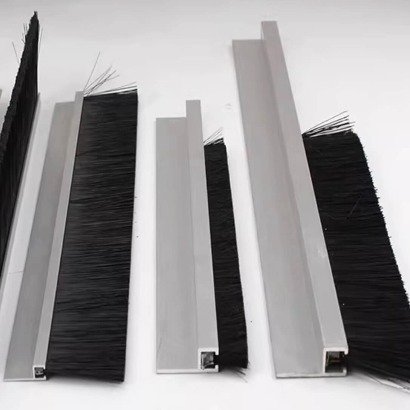
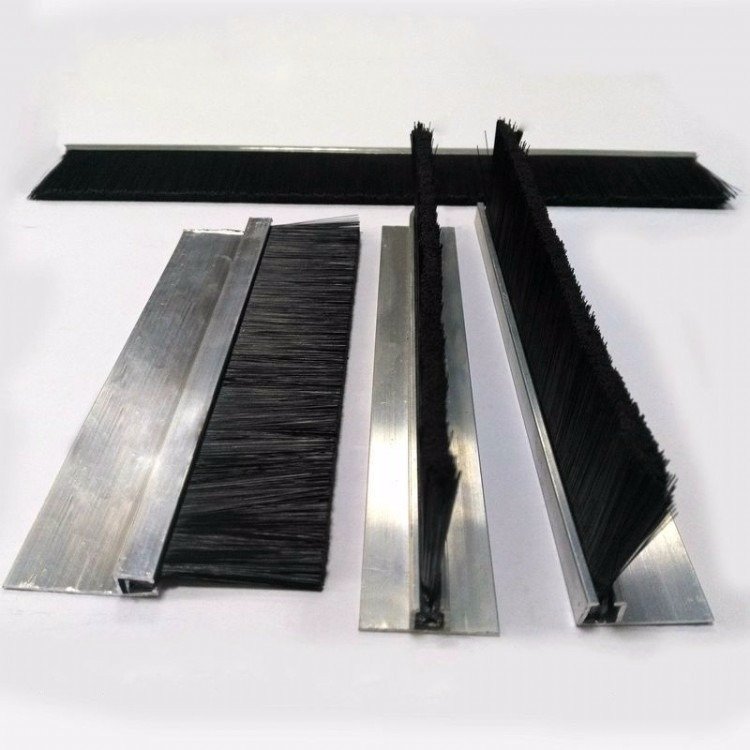
The main function of the strip brush aluminum holder is to serve as the support structure of the strip brush. It provides fixation and protection for the bristles, ensuring the stability and durability of the strip brush in the application. According to its structure and purpose, it can be divided into H-type, F-type and Y-type. Common aluminum holder materials include: pure aluminum holders, aluminum alloy holders, aluminum oxide holders and coated aluminum holders. So how should aluminum holders of different materials and shapes be selected?
H-type strip brush aluminum holder:
Structural features: The H-type strip brush aluminum holder, in structural terminology, is an aluminum alloy bracket shaped like the uppercase “H.” This has a design of good support and stability.
Use: H-type strip brush aluminum holder is applied at places where sealing, dustproof, waterproofing, insulation against cold and heat, sound insulation, etc., functions are needed, for instance, industrial doors, fast rolling doors, fast stacking doors, and so on.
Features: Dense, non-shedding bristles are easy to install.
F-type strip brush aluminum holder:
Structural features: It has an aluminum alloy bracket whose shape is that of the letter “F”. Generally, this kind of design is made as per certain installation space or function-oriented requirements.
The Y-type strip brush aluminum holder would work with certain applications requiring something like smaller door gaps, window gaps, or other places. The brushes will be of special shapes.
Features: Special installation method or ability to adapt to specific size requirements.
Y-type strip brush aluminum holder:
Structural features: The aluminum bracket of the strip brush aluminum holder is the shape of the letter “Y”. This design is created primarily to give much better support and fit different angles at the time of installation.
Use: Where necessary, the Y-type strip brush aluminum holder is required to take a much wider variety of angles of installation or special shapes of bristles.
Features: It might be much more adaptable and can fulfill different shapes plus sizes.
Aluminum Holder Types
It should be noted that different types of strip brush aluminum holders may differ in material, size, bristle type, installation method, etc. When choosing, the most suitable type should be determined according to the specific use environment and needs.
Compared to aluminum holders, holders made of other materials have both positive and negative properties. The following is a summary of the characteristics of aluminum holders compared to some common materials:
Pure aluminum holders:
Pros: lightweight, cheap, good electrical and thermal conductors.
Cons: low strength, low wear and corrosion resistance, deformable.
Aluminum Alloy Holders (e.g., 6061, 6063 Aluminum Alloy):
Advantages: high strength, lightweight, good corrosion resistance, easy to shape.
Disadvantages: Higher cost than pure aluminum, and some high-strength aluminum alloys may be poor in their welding performance.
Hard anodized aluminum holders:
Advantages: High surface hardness, good wear resistance, excellent corrosion resistance, and good appearance decoration.
Disadvantages: Limited thickness of the hard oxide layer, not applicable to very high wear applications, and expensive.
Stainless steel aluminum holders (stainless steel + aluminum alloy composite material):
Pros: Very good corrosion resistance, high strength, and appropriate for heavy-duty applications.
Cons: Very expensive, heavier than aluminum alloy, and more difficult to machine.
Coated Aluminum Brackets (e.g., zinc and chrome-plated):
Pros: The coating will provide extra protection plus enhance corrosion and wear resistance.
Cons: Coating wears or peels off with time under harsh conditions, might need re-plating.
In selecting the aluminum holder material, the application scenario, budget, required physical properties, and chemical properties should be kept in mind. In high-strength and corrosion-resistance demands for industrial purposes, aluminum alloy or stainless steel aluminum holders would be preferable; however, in low-cost and more gentle environments, pure aluminum or plastic aluminum holders may be adequate.